 Skip to content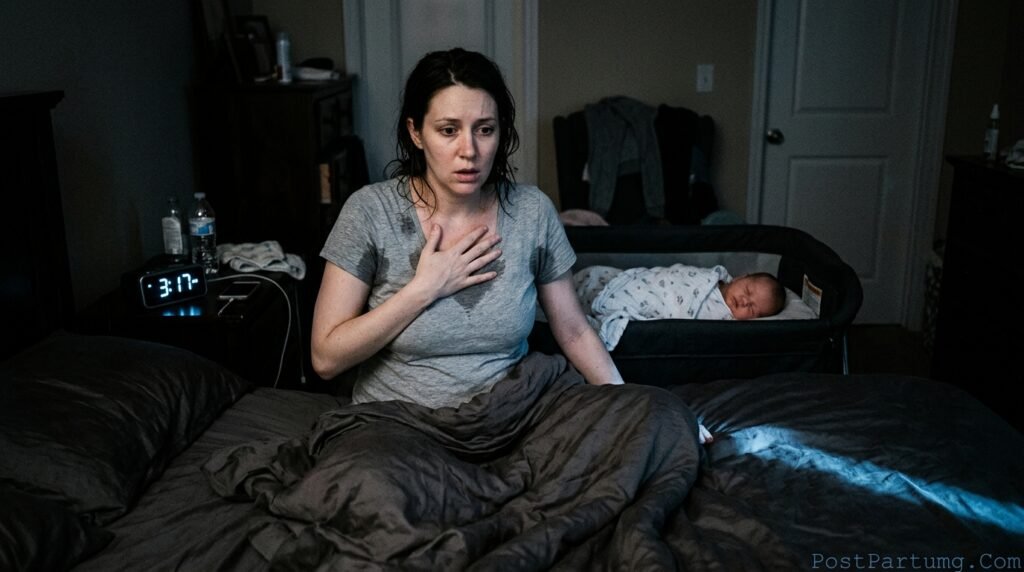
You wake up at 3 am drenched. The sheets are soaked. Your face is flushed and your heart is pounding. Then, minutes later, you’re cold again.
If this sounds familiar, you’re in good company. Postpartum hot flashes affect at least 10% of new mothers — and as many as one in three — making them one of the most common yet least discussed physical experiences after birth.
Most new mothers are completely blindsided by this. Nobody mentions it at prenatal classes. It doesn’t come up much in birth preparation books. And because it doesn’t have the dramatic status of postpartum depression or the visibility of lochia, it often gets dismissed — even though it disrupts sleep, raises anxiety, and makes an already demanding period genuinely harder.
This article explains exactly what’s driving postpartum hot flashes, how long they typically last, what helps, and — critically — which symptoms are warning signs of something that needs medical attention.
What’s Actually Causing the Heat
The Estrogen Crash
The primary cause of postpartum hot flashes is hormonal. Estrogen and progesterone levels plummet after you give birth — and sweating is a direct reaction to these hormonal fluctuations.
Here’s the specific mechanism. Your hypothalamus — the small region of the brain that acts as your body’s internal thermostat — is acutely sensitive to estrogen levels. Specifically, hormonal changes affect the hypothalamus in a way that low estrogen makes it believe you’re too hot. Your brain tells your body to cool you off. This results in excessive sweating.
This is the same process that causes hot flashes in menopause. The difference is compression: in menopause, the estrogen decline happens over years. After delivery, estrogen and progesterone fall steeply within days from their very high pregnancy levels — that rapid drop transiently destabilises the hypothalamic temperature set point, the same mechanism as menopausal flashes, compressed into a few weeks.
Fluid Offloading: The Other Driver of Early Sweating
Postpartum fluid offloading is another key driver. The body sheds the extra fluid accumulated in pregnancy, much of it through sweating, especially at night in the first one to two weeks. Drenching early night sweats are typically this.
Your blood volume increases by approximately 50% during pregnancy. Once the baby is delivered and your body no longer needs that extra fluid, it begins eliminating it — and sweat is one of the primary pathways. This kind of sweating is most intense in the first week or two and then eases noticeably as fluid levels normalize.
How Breastfeeding Extends the Duration
Lactation keeps estrogen relatively low and prolactin high, so breastfeeding women often have flashes and night sweats for longer — sometimes for months while nursing.
If you’re breastfeeding and wondering why your hot flashes seem to outlast those of formula-feeding friends, this is why. Your body is intentionally maintaining a lower estrogen environment to support milk production. The hot flashes are a side effect of that environment, not a problem with your hormones.
Sleep Deprivation as an Amplifier
Fragmented newborn sleep raises cortisol and lowers the flushing threshold on top of the hormonal change — meaning the same hormonal environment produces worse hot flash symptoms when combined with sleep deprivation. This is why many women feel like their hot flashes peak in the second and third weeks rather than the first: the hormonal drop has happened but the sleep debt is compounding.

How Common Are They and How Long Do They Last?
Research published in Fertility and Sterility (Thurston et al., 2013) and reviewed by the Sleep Foundation provides the clearest current picture of postpartum hot flash prevalence and duration.
| Timeframe | Hot Flash Prevalence |
|---|---|
| First two weeks postpartum | ~20% of women report hot flashes (peak period) |
| Week 12 postpartum | ~14% of women still reporting |
| One year postpartum | ~10% still experiencing some episodes |
| During breastfeeding period | Extended duration common — variable |
Limited research suggests the incidence of night sweats peaks at two weeks postpartum, with about 20% of people reporting hot flashes during this time. The same study showed the prevalence dropped to 14% by week 12. About a year after giving birth, 10% of people still reported postpartum hot flashes.
The good news is that for most women the frequency and intensity decrease significantly by the 6–8 week mark. For women who breastfeed, mild episodes may continue throughout the nursing period but typically become much less disruptive over time.
What Postpartum Hot Flashes Feel Like
Knowing the typical presentation helps you recognize what you’re dealing with — and distinguish it from other postpartum symptoms.
Common experiences:
- Sudden intense warmth spreading across the face, neck, and chest
- Profuse sweating — often soaking nightwear and sheets
- Rapid heartbeat or palpitations during an episode
- Flushing or redness of the face
- A brief feeling of panic or anxiety accompanying the heat surge
- Chills immediately following a hot flash as body temperature overcorrects
Daytime vs. nighttime: Postpartum night sweats refer to sweating more than usual at night — the sweating might wake you and require you to wash your bedding or even shower in order to get comfortable and get back to sleep. This can be disruptive to both sleep and routine. But hot flashes can also occur during the day, particularly during or after breastfeeding sessions when prolactin is surging.
Postpartum Hot Flashes vs. Postpartum Fever: A Critical Distinction
This is the most important section in this article. Hot flashes and fever can feel similar in the moment — both involve sudden heat, flushing, and sweating. Knowing the difference protects your health.
| Feature | Postpartum Hot Flash | Postpartum Fever |
|---|---|---|
| Temperature | Normal body temp (98–99°F / 36.7–37.2°C) | Elevated — 100.4°F / 38°C or above |
| Pattern | Brief episode (minutes), then resolves | Sustained elevation that doesn’t fluctuate normally |
| Associated symptoms | Sweating, flushing, brief palpitations | Chills, body aches, wound pain or redness |
| Duration of episode | 1–5 minutes typically | Hours |
| Breast symptoms | None typical | Possible mastitis: hard red area, flu-like feeling |
The rule: If you can take your temperature during the episode and it reads 100.4°F (38°C) or above, this is a fever — not a hot flash — and it warrants a call to your healthcare provider. A temperature above 100.4°F in the postpartum period is always worth investigating.
Postpartum fever can indicate uterine infection, wound infection, mastitis, or — rarely — more serious conditions including postpartum preeclampsia. Our comprehensive guide on postpartum infection symptoms and our article on postpartum night chills and fever cover these warning signs in full detail.
The Thyroid Connection: What Not to Miss
Thyroid must be considered. Postpartum thyroiditis is common in the months after birth and causes heat intolerance, palpitations, sweating, and mood change. It is the key medical cause not to miss.
Postpartum thyroiditis affects approximately 5–10% of women after birth, according to the American Thyroid Association (ATA). Its hyperthyroid phase — which can occur between one and four months postpartum — produces symptoms that closely overlap with hot flashes: sweating, warmth intolerance, rapid heartbeat, anxiety, and fatigue.
The difference between thyroid-driven symptoms and normal postpartum hot flashes:
- Thyroid symptoms tend to be more persistent and not improving with time
- Often accompanied by unexpected weight loss, hair thinning, or heart palpitations at rest
- Don’t follow the normal postpartum hot flash pattern of peaking in weeks 1–2
A simple TSH (thyroid-stimulating hormone) blood test can identify thyroid dysfunction. Ask your OB or midwife for this test if your symptoms are intensifying rather than gradually improving, or if they’re accompanied by other thyroid signs.
Practical Relief Strategies
You cannot stop postpartum hot flashes entirely — they’re a physiological response to hormonal changes that are working correctly. But you can meaningfully reduce their impact on your sleep and daily comfort.
Sleep Environment
Lower your room temperature. The optimal sleep temperature is around 65–68°F (18–20°C) for most adults. Going slightly cooler helps buffer against hot flash episodes. A fan pointed at your bed serves dual purpose — the moving air helps cool you during an episode and provides white noise for better sleep.
Layer your bedding. Use breathable cotton or bamboo sheets that you can easily push off during a flash, and keep a light blanket nearby for the chill that follows.
Keep water beside your bed. Cold water during an episode helps lower core temperature quickly and replaces fluid lost through sweating.
Clothing
Moisture-wicking sleepwear — specifically designed to pull sweat away from skin — makes a significant practical difference compared to regular cotton when soaking episodes happen. Bamboo fabric is particularly breathable.
Dress in loose, breathable layers during the day. The ability to remove a layer quickly when a flash starts is more useful than any other clothing strategy.
Daytime Management
Stay well hydrated. Sweating depletes fluid. For breastfeeding mothers already running a fluid deficit from milk production, this matters even more. Aim for pale yellow urine as your hydration guide.
Reduce caffeine. Caffeine can lower your threshold for hot flashes by stimulating the nervous system. This is not an absolute rule — but if your flashes feel particularly frequent, reducing coffee or tea temporarily is worth trying.
Eat regular meals. Blood sugar fluctuations can trigger flushing. Eating consistently through the day — including protein and complex carbohydrates at each meal — stabilizes blood sugar and reduces flush triggers. Our postpartum meal prep guide has easy, nutrient-dense meal ideas ready for busy postpartum days.
Stress and Sleep
There is a direct relationship between cortisol (your stress hormone) and hot flash frequency. Sleep deprivation and stress raise cortisol and lower the flushing threshold on top of the hormonal change. This means anything that genuinely reduces your stress and improves your sleep also reduces hot flash frequency — even if it doesn’t eliminate them.
Protecting sleep — through a postpartum doula, partner night shifts, or whatever support you can access — addresses the amplifier as much as the hot flash itself. See our guide on building your postpartum village for practical ideas on organizing overnight and daytime support.

When Hot Flashes Connect to Postpartum Mood
The predictors of postpartum hot flashes, including depressive symptoms, have been found to be similar to those experienced during menopause. Research from Thurston et al. (2013) published in Fertility and Sterility found that depressive symptoms were associated with higher rates of hot flashes during both pregnancy and postpartum.
This isn’t coincidence — the same estrogen pathways that drive temperature dysregulation also influence serotonin and mood. Women experiencing more severe or prolonged hot flashes are statistically more likely to also be experiencing postpartum anxiety or depression.
If your hot flashes are severe, disruptive to your functioning, or accompanied by persistent low mood or anxiety, please raise both at your next provider visit. Treating an underlying mood disorder often reduces hot flash frequency alongside improving mood — they share biology.
Does Breastfeeding Affect Recovery?
Yes — in two ways. Breastfeeding extends the low-estrogen environment that drives hot flashes, meaning breastfeeding mothers often experience them for longer. At the same time, the act of nursing itself involves prolactin surges that can trigger mild flushing in some women during the feed.
Weaning typically brings hot flash frequency down significantly within a few weeks as estrogen begins recovering. But weaning itself triggers another hormonal adjustment — some women notice a temporary intensification of sweating and mood symptoms in the first two to four weeks after stopping nursing.
This is a normal transition. If symptoms after weaning are severe or prolonged beyond a few weeks, discuss them with your provider.
How This Connects to Other Postpartum Physical Changes
Postpartum hot flashes are part of a broader hormonal recalibration affecting multiple body systems simultaneously. The same estrogen decline that drives temperature dysregulation is also responsible for:
- Postpartum hair loss — typically beginning around 3 months postpartum
- Vaginal dryness after baby — low estrogen thins vaginal tissue during breastfeeding
- Skin changes after pregnancy — including dryness and texture shifts
- Postpartum weight retention — hormonal factors affecting metabolism
Understanding these as connected expressions of one hormonal shift — rather than separate problems each requiring their own solution — can make the postpartum recovery picture feel more coherent and less overwhelming.
Myth vs. Fact
Myth: Postpartum hot flashes mean something is wrong with your hormones. Fact: They are a normal, expected physiological response to the sharp estrogen drop after delivery. The mechanism is well understood. The vast majority of cases require no treatment.
Myth: Hot flashes only happen if you’re not breastfeeding. Fact: Breastfeeding actually extends the duration of hot flashes for many women, because lactation maintains a lower estrogen environment. Non-breastfeeding mothers typically see resolution faster — but nursing mothers experience them too.
Myth: Night sweats are the same as a postpartum fever. Fact: Night sweats involve normal or near-normal body temperature. Fever is a sustained temperature of 100.4°F or above and requires medical evaluation. Taking your temperature during an episode is the reliable way to distinguish them.
Myth: Hot flashes after birth will last as long as menopausal ones. Fact: Postpartum hot flashes resolve as hormones recover — most significantly by 6–8 weeks, with residual episodes decreasing through the first year. Menopausal hot flashes occur in a context of permanent estrogen decline. These are fundamentally different situations.
When to Contact Your Healthcare Provider
Contact your OB or midwife if:
- Episodes are accompanied by a temperature of 100.4°F (38°C) or above
- You notice your symptoms are intensifying rather than gradually improving beyond week 4
- Heart palpitations at rest (not just during a flash) persist alongside sweating and heat intolerance — thyroid evaluation needed
- Unexpected weight loss accompanies your symptoms
- Mood symptoms — anxiety, low mood, panic — are significant and persistent alongside the hot flashes
Seek immediate care if:
- Fever above 100.4°F with breast pain, redness, or flu symptoms — possible mastitis
- Fever with pelvic pain or foul-smelling discharge — possible uterine infection
- Severe sudden headache or vision changes alongside flushing — possible postpartum preeclampsia
- You feel genuinely unwell in a way that’s different from normal postpartum adjustment

Frequently Asked Questions
For most women, the most intense episodes occur in the first two weeks, with meaningful improvement by six to eight weeks. Women who breastfeed may experience milder episodes for the duration of nursing. About a year after giving birth, 10% of people still report postpartum hot flashes — so while most resolve, a small percentage continue longer.
Some women notice an apparent worsening in the second and third week as sleep deprivation compounds the hormonal effect. This is not unusual and doesn’t indicate the process is going in the wrong direction.
For most women, environmental management (cool room, breathable clothing, hydration) and time are the primary tools. Hormone therapy is generally not used for postpartum hot flashes because the estrogen drop is expected and temporary. If symptoms are severe, discuss with your OB whether any short-term options are appropriate for your specific situation.
Not consistently. The experience varies between pregnancies and is influenced by breastfeeding duration, thyroid function, and individual hormonal sensitivity rather than pregnancy number.
Focus on what you can control: room temperature, bedding, clothing, and hydration. If sleep disruption is severe, discuss with your provider whether any short-term support is appropriate. Addressing the broader sleep deprivation problem — through partner support or a postpartum doula — addresses the amplifier even if it doesn’t directly reduce the flashes.
They can overlap with postpartum thyroiditis symptoms. If your flashes are not following the expected pattern of improvement, or if they’re accompanied by persistent palpitations, unexpected weight changes, or hair loss beyond typical postpartum shedding, ask your provider to check your TSH levels.
Sources
- Thurston RC, Luther JF, Wisniewski SR, Eng H, Wisner KL — “Prospective Evaluation of Nighttime Hot Flashes During Pregnancy and Postpartum,” Fertility and Sterility (2013) — PubMed
- Sleep Foundation — Postpartum Night Sweats: Causes and Management, July 2025
- Cleveland Clinic — Postpartum Night Sweats: Causes and Treatments
- American Thyroid Association (ATA) — Postpartum Thyroiditis
- Mito Health — Hot Flashes Postpartum: Why They Happen and When to Worry, April 2026
- Tidewater OB-GYN — Postpartum Hot Flashes: Causes, Symptoms and Relief Tips
- American College of Obstetricians and Gynecologists (ACOG) — Postpartum Care Guidelines
All information reflects evidence available as of 2026.


