 Skip to content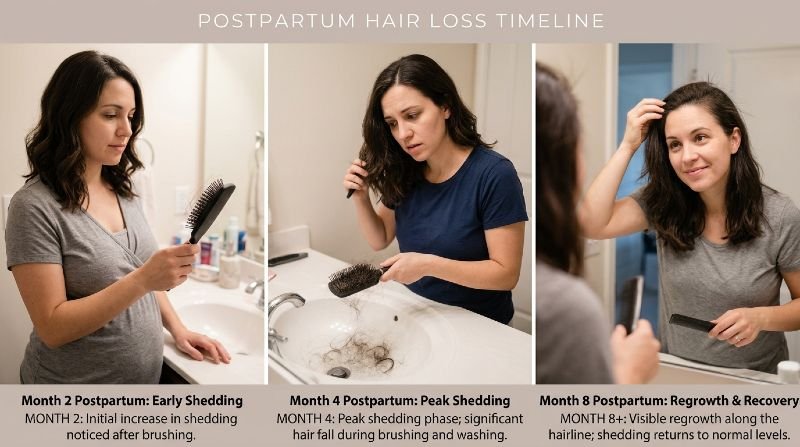
You reached for your brush this morning. Then you froze. The amount of hair wrapped around the bristles was shocking. You checked the shower drain too — more hair. Way more than before. And now you’re wondering if something is seriously wrong.
Here’s the truth. Postpartum hair loss is one of the most common things that happens to women after birth. Research shows that up to 50% of new mothers experience noticeable hair shedding, according to the American Academy of Dermatology (AAD). Yet almost no one talks about it during pregnancy.
This article walks you through the full postpartum hair loss timeline — why it happens, what’s normal, what needs attention, and what genuinely helps. You’re not broken. Your body is doing something completely expected.
Why Does Postpartum Hair Loss Happen?
To understand the shedding you’re experiencing, a quick biology lesson helps. And it’s genuinely simple.
The Normal Hair Growth Cycle
Your hair doesn’t all grow at the same time. Each strand goes through its own independent cycle with three main phases:
- Anagen — the active growth phase. Hair grows steadily for two to seven years.
- Catagen — a short transition phase lasting about two to three weeks.
- Telogen — the resting phase. Hair rests for about three months before falling out.
Under normal conditions, about 85–95% of your hair is in the growth phase at any given time. That’s why you only lose about 50–100 strands per day normally.
What Pregnancy Does to Your Hair
During pregnancy, your estrogen levels skyrocket. This hormonal shift supports your baby — but it also does something interesting to your hair: high estrogen essentially freezes your hair in the growth phase, preventing the normal shedding that would otherwise happen. So throughout your nine months of pregnancy, your hair barely falls out at all. This is why so many women have thick, full hair during pregnancy — it’s not a myth. Your hair genuinely accumulates.
The Postpartum Drop That Changes Everything
After birth, your estrogen levels fall sharply and fast. Your body essentially “catches up” on all the shedding it postponed during pregnancy. All that hair that was held in the growth phase suddenly shifts into the resting and shedding phase at once.
Instead of losing 50–100 strands a day, you may lose 300 or more. This condition has a medical name: telogen effluvium — a large portion of hair entering the resting phase simultaneously and then shedding together. According to research published in the Journal of Clinical and Aesthetic Dermatology, postpartum telogen effluvium is one of the most common causes of temporary hair loss in women of reproductive age.
It looks alarming. It’s not dangerous. And it’s not permanent.
The Postpartum Hair Loss Timeline: Phase by Phase
| Phase | Timing | What You Notice |
|---|---|---|
| Stable Period | Birth to Week 8 | Minimal shedding. Hair feels full from pregnancy. |
| Peak Shedding | Weeks 8–16 | Heavy shedding. Clumps in drain and brush. |
| Gradual Slowing | Months 4–6 | Shedding decreases. Baby hairs appear at hairline. |
| Active Regrowth | Months 6–12 | Short hairs along hairline. Visible new growth. |
| Full Recovery | Months 12–18 | Normal density returns. Hair feels balanced again. |
Phase 1: The Stable Period (Birth to Week 8)
In the first few weeks after birth, most women don’t notice extra shedding. Your hair may still feel thick from pregnancy — some women even feel relieved, thinking they escaped it entirely. This is the delay phase. Your hair is entering the resting stage but hasn’t started falling yet.
Phase 2: Peak Shedding (Weeks 8–16)
This is when most women first notice and panic. Hair starts coming out in clumps. The shower drain fills quickly. You might notice thinning around your temples or along your hairline. Peak shedding typically occurs around three to four months after birth — corresponding directly to the natural three-month delay of the telogen effluvium cycle.
For some women shedding starts earlier, for others later. Both are normal.
Phase 3: Gradual Slowing (Months 4–6)
By four to six months postpartum, most women notice shedding starting to slow. You may still see more hair than pre-pregnancy — but the drain is no longer as overwhelming. This phase also marks the beginning of new growth for many women. Look closely at your hairline. You might start seeing short, fine baby hairs sprouting.
Phase 4: Active Regrowth (Months 6–12)
This phase requires the most patience. New hair grows in but doesn’t match the rest of your hair yet. You’ll notice short strands along your hairline — often called the “postpartum halo.” New hair grows roughly half an inch per month, so it takes time before things look fully back to normal.
Phase 5: Full Recovery (Months 12–18)
For most women, hair returns to its pre-pregnancy density somewhere between 12 and 18 months after birth. If you’re breastfeeding, your timeline may shift slightly because your hormones stay in flux longer. This is normal and not a cause for concern.

What Normal Shedding Looks Like — vs. What Needs Attention
Normal postpartum shedding usually looks like:
- Heavy shedding concentrated in the shower and while brushing
- Thinning at the temples or along the hairline
- Overall reduced volume without completely bare patches
- Shedding that starts a few weeks after birth and peaks around month three or four
- Gradual slowing and regrowth after peak shedding ends
Shedding that may need medical attention:
- Completely bare patches on the scalp
- Shedding that continues past 12 months with no improvement
- Hair loss accompanied by extreme fatigue or unexplained weight changes
- Scalp irritation or pain alongside shedding
- Thinning eyebrows or eyelashes in addition to scalp hair loss
The second list may point to something other than telogen effluvium — thyroid conditions and nutritional deficiencies can also cause hair loss and require different treatment. Please speak with your healthcare provider if anything from that second list sounds familiar.
Factors That Can Make Shedding Worse
Not all postpartum shedding is equal. Certain factors can amplify the process.
Nutritional Deficiencies
Your body just built an entire human. That process depletes nutrients. Iron deficiency is extremely common after birth — especially after significant blood loss during delivery — and is a well-documented trigger for additional hair shedding on top of telogen effluvium, according to the NIH Office of Dietary Supplements.
Other nutrients that affect hair health include:
- Zinc — supports hair follicle function
- Biotin (a B vitamin) — supports keratin production
- Vitamin D — plays a role in the hair growth cycle
- Protein — hair is made almost entirely of it
A simple blood test can show whether you’re deficient in any of these.
Thyroid Imbalances
Postpartum thyroid disease affects approximately 5–10% of women after birth, according to the American Thyroid Association (ATA). It can cause additional hair shedding that looks very similar to regular telogen effluvium — but it doesn’t resolve on its own without treatment. If your hair loss feels extreme or comes with fatigue, mood changes, or unusual weight shifts, ask your doctor to check your thyroid levels.
High Stress Levels
Chronic stress keeps your body in a heightened state. This can extend or worsen the shedding phase, and sleep deprivation makes it harder for your body to prioritize hair regrowth. Any small stress reduction helps — and our article on mom burnout signs covers this broader picture.
Heat and Chemical Damage
Damaged hair breaks more easily. When you’re already in a shedding phase, breakage makes hair loss look worse than it actually is. Frequent heat styling and chemical treatments during this period add unnecessary damage.
Practical Steps to Support Your Hair Right Now
You cannot stop the shedding. But you can absolutely support your scalp and your regrowth.
Nourish from the inside: Continue taking your prenatal vitamin if you’re still in the first postpartum year. Focus on protein in your meals — eggs, lentils, legumes, lean meats, and fish provide the essential building blocks for hair. Iron-rich foods like spinach, red meat, and fortified cereals directly support hair follicle health.
Be gentle with your hair:
- Use a wide-tooth comb instead of a fine bristle brush
- Detangle from the ends upward
- Avoid tight hairstyles that pull on the hairline
- Let your hair air dry when possible
- Sleep on a satin or silk pillowcase to reduce friction
Scalp massage: A 2019 study published in Eplasty found that regular scalp massage significantly increased hair thickness over time by improving blood flow to the follicles. Use your fingertips in small circles for four to five minutes daily — in the shower or dry, both work.
Choose the right shampoo: Look for gentle, volumizing formulas. Avoid heavy silicone-based products that weigh down fine new growth. Clean scalp equals healthier follicles — some women avoid washing hoping to reduce shedding, but hair that’s going to shed will shed regardless of washing frequency.
Pro Tip: If you’ve been considering a haircut, peak shedding time is actually not a bad moment. A shorter cut or added layers can make volume loss look less dramatic — and the visual difference during the worst weeks can be genuinely helpful for your confidence.

Postpartum Hair Loss and Breastfeeding
Breastfeeding itself does not directly trigger extra shedding. But it does keep your hormones in flux longer — which can extend the postpartum hair loss timeline by a few months for some women.
Breastfeeding also increases your nutritional needs significantly. If you’re not eating enough calories or getting adequate iron and zinc, your hair may suffer more than it otherwise would. Eat generously. Your body is doing something remarkable.
When you wean, another hormonal shift occurs and some women notice a brief increase in shedding. This is temporary and resolves as hormones stabilize.
Myth vs. Fact
Myth: Breastfeeding causes extra hair loss. Fact: Breastfeeding delays regrowth slightly by maintaining hormonal flux — but doesn’t directly cause additional shedding.
Myth: Cutting your hair stops the shedding. Fact: Shedding happens at the root. Cutting the length has no effect on the telogen effluvium process.
Myth: Expensive hair treatments can fix it. Fact: No topical product stops telogen effluvium. Only time, nutrition, and correction of any underlying deficiencies genuinely help.
Myth: You’ll never get your hair back. Fact: According to the AAD, almost all women regain their pre-pregnancy hair density within 12–18 months after birth.
Myth: Biotin supplements will dramatically speed up regrowth. Fact: Biotin helps if you have a genuine deficiency. But for most women, biotin alone won’t significantly accelerate the natural regrowth cycle. A balanced diet and prenatal vitamins provide a stronger foundation overall.

When to Contact Your Doctor
Most postpartum hair loss resolves on its own. But call your doctor or midwife if you notice:
- Shedding that continues past 12 months without any improvement
- Bare, circular patches on your scalp
- Hair loss spreading to your eyebrows or eyelashes
- Extreme fatigue alongside hair loss
- Unexplained weight gain or loss at the same time as shedding
- Scalp pain or significant irritation
These symptoms can point to thyroid conditions like postpartum thyroiditis — or nutritional deficiencies that need specific treatment. Early testing gives you answers and options.
Frequently Asked Questions
For most women, the shedding phase lasts about three to six months. It typically peaks around three to four months postpartum. Full regrowth usually happens by 12 to 18 months after birth, per AAD data.
For the vast majority of women, yes. Hair density returns to its pre-pregnancy baseline within 18 months. Some women notice a slight change in hair texture after birth — this is normal and usually a temporary shift.
Biotin supplements may help if you have a genuine biotin deficiency. For most women, biotin alone won’t dramatically speed up the natural regrowth cycle. A balanced diet and prenatal vitamins provide a stronger foundation.
It varies. Some women experience similar shedding with each postpartum period. Others find it’s different each time. The process is individual and influenced by nutrition, stress, and hormonal factors specific to each pregnancy.
Weaning causes another hormonal shift. Some women notice a brief increase in shedding when they wean. This is temporary and resolves as hormones stabilize — typically within a few weeks to months.
Sources
- American Academy of Dermatology (AAD) — Why Hair Falls Out After Having a Baby
- American Thyroid Association (ATA) — Postpartum Thyroiditis
- NIH Office of Dietary Supplements — Iron and Hair Health
- Journal of Clinical and Aesthetic Dermatology — Postpartum Telogen Effluvium Research
- Eplasty — Scalp Massage and Hair Thickness (2019)
- National Institutes of Health (NIH) — Nutritional Deficiencies and Hair Loss
All information reflects evidence available as of 2026.


