 Skip to content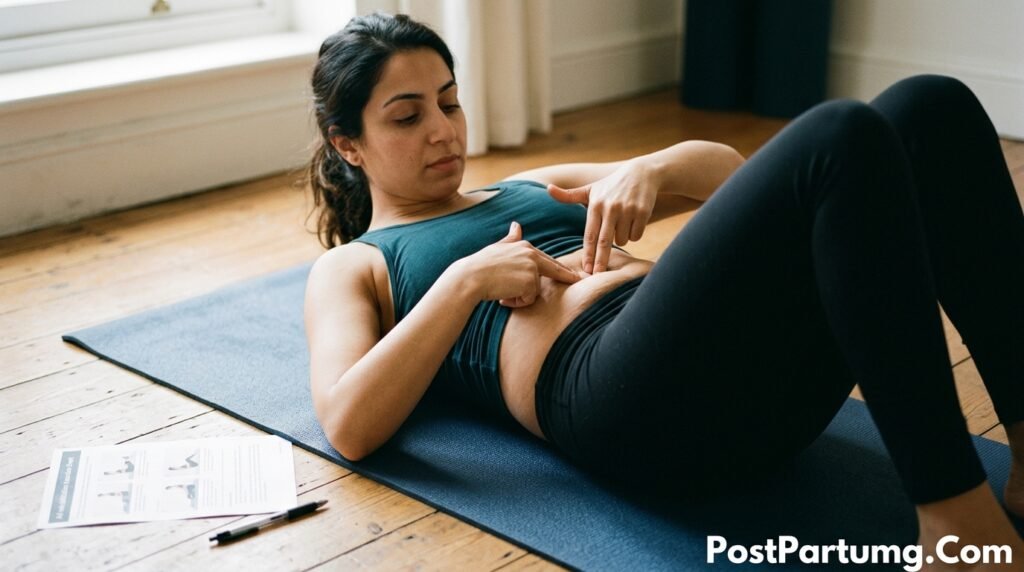
Let’s start with what’s wrong.
Crunches will close the gap. A belly binder will heal your core. If your stomach still pooches at six months, you didn’t try hard enough. Diastasis recti is just cosmetic. You’ll need surgery.
Every one of those statements is either false, misleading, or oversimplified — and yet most of them circulate freely in postpartum groups, fitness content, and even some healthcare settings. Diastasis recti can be physically and emotionally frustrating. It’s also frequently misunderstood in ways that lead women toward the wrong exercises, unrealistic timelines, and sometimes real harm.
So let’s start from the beginning.
What’s Actually Happening Inside Your Abdomen
Diastasis recti is the separation of the rectus abdominis muscles — the pair of muscles that run vertically along the front of your stomach, commonly called the “six-pack” muscles. They’re divided into left and right sides by a band of connective tissue called the linea alba. During pregnancy, as the uterus expands, this connective tissue stretches and the two muscle columns move apart.
The critical word there is connective tissue. This is not simply a gap between muscles that you can squeeze shut by doing the right exercises. The linea alba — the tissue bridging those columns — has been mechanically loaded and hormonally softened for nine months. The gap is a consequence of that tissue losing tension. Gap width is part of the picture, but so is tissue quality: a 3-finger gap with firm, load-bearing connective tissue functions better than a 2-finger gap where the tissue is soft and slack.
More than 60% of women experience diastasis recti during pregnancy. The affected muscles often come back together after delivery — it can take up to a year. However, some women need pelvic floor physical therapy and at-home exercises to fix the problem.
That one-year timeline is important. Many women assess themselves at six weeks, find a gap, and conclude they have a serious problem. Sometimes they’re right. Often the gap is still in natural recovery, and the most important intervention is patience combined with the right foundational work — not aggressive exercise.

The Symptom That’s Hiding in Plain Sight
During pregnancy, you may not have noticeable symptoms of abdominal separation. After delivery, the most noticeable symptom is a bulge or “pooch” in your belly area. Even though you’re no longer pregnant, it might look like you still are.
But diastasis recti is not just about appearance. Additional symptoms include lower back pain, poor posture, constipation, and bloating. Many women with significant diastasis recti don’t primarily complain about how their stomach looks — they complain about a back that never stopped hurting after birth, a core that collapses under simple loads like picking up a toddler, or leaking when they cough.
You may feel weakness in your core when doing once-easy tasks, like lifting a laundry basket. Some people feel a jelly-like texture in the space between the left and right abdominals when contracting their ab muscles.
That “jelly” sensation — pressure doming outward from the midline during effort — is one of the most reliable functional indicators that diastasis recti is affecting your core’s ability to manage load. It’s also a red flag that you’re doing exercises your system can’t yet handle.
The Self-Check: What It Tells You and What It Doesn’t
Here’s how to assess yourself:
- Lie on your back with knees bent, feet flat on the floor
- Place your fingertips horizontally across your midline, just above your navel
- Lift only your head and shoulders off the floor — a small crunch movement
- Feel whether your fingers drop into a gap, and count how many finger-widths fit
If you feel a gap of more than two fingers or a bulge in the central line of your abdomen, you might have diastasis recti. If you think you have diastasis recti, the first step is to consult with your OB-GYN to confirm the diagnosis.
What the self-check cannot tell you: the quality of the tissue at the base of the gap. Two fingers wide with taut, firm connective tissue underneath functions very differently from two fingers wide where your fingers sink into soft, yielding tissue with no resistance. You can feel this if you pay attention — does the gap have a trampoline-like firmness beneath it, or does it feel like pressing into foam?
Diagnosis usually involves a physical exam done by your healthcare provider. Ultrasound imaging provides the most accurate picture of gap width and linea alba integrity simultaneously. If your symptoms are significant, an ultrasound assessment through a pelvic floor physical therapist or physiotherapist gives you real data rather than finger-guesses.
What’s Actually Causing Your Belly to Still Look Pregnant
This question deserves a direct answer, because the internet conflates several different things.
A persistent postpartum belly pooch can come from:
| Cause | What It Looks Like | What Helps |
|---|---|---|
| Diastasis recti | Ridge or dome along midline; worse with effort or getting up | Pelvic floor PT, specific reconnection exercises |
| Subcutaneous fat redistribution | General softness around midsection; no specific ridge | Gradual weight changes over time |
| Skin laxity | Loose or crepey skin, especially below navel | Collagen support, time — does not respond to exercise |
| Bloating and digestive changes | Variable day to day; worse after meals | Dietary adjustment, hydration |
| Pelvic floor dysfunction | Lower belly fullness or heaviness, worse later in day | Pelvic floor PT — see our pelvic floor recovery guide |
| Uterine involution still in progress | Early postpartum — uterus still shrinking | Time — resolves by 6–8 weeks |
Treating all of these as “diastasis recti” leads to exercises that won’t help and sometimes make things worse. Treating none of them leaves real dysfunction unaddressed.
The Exercises That Help — and the Ones That Make It Worse
This is where the practical stakes are highest. Because the wrong exercises — done with good intentions — can actively worsen diastasis recti.
What to avoid until your system is ready:
Traditional crunches and sit-ups. During pregnancy, abdominal exercises like crunches and sit-ups should be avoided because they put a lot of pressure on the abdominal muscles and can worsen the separation. After birth, the same principle applies until linea alba function is restored. Crunches generate high intra-abdominal pressure directed straight at the midline. On an already compromised linea alba, this can worsen the gap or impair healing connective tissue.
Double leg raises. Severe load on a core that can’t yet manage it.
Heavy lifting with breath-holding. Valsalva maneuver (holding your breath while exerting force) spikes intra-abdominal pressure dramatically. Until your core system can manage pressure properly, exhale on every exertion.
The functional test that tells you if an exercise is appropriate: During the movement, look at your midline. If you see doming (a ridge or cone pushing outward) or feel the gap widening, the load is too much for your current recovery stage. Reduce the demand or stop that exercise entirely.
What actually helps — in sequence:
Phase 1: Reconnection (weeks 0–6 postpartum) 360-degree diaphragmatic breathing — breathing that expands your ribcage in all directions, coordinated with a gentle pelvic floor lift on exhale. This isn’t optional warm-up. For diastasis recti, breath mechanics are the treatment.
Phase 2: Foundational loading (weeks 6–16) Dead bugs, bird dogs, heel slides, glute bridges with proper breath timing. All performed with continuous breathing and monitoring for midline doming.
Phase 3: Progressive strength (months 4–6) Functional movement patterns — squats, hinges, carries — with appropriate load and exhale-on-exertion technique.
Phase 4: Return to full activity (6+ months) Running, HIIT, heavy lifting — only when the system demonstrates it can manage the load without compensation.
Exercises to treat diastasis recti can usually begin 6 to 8 weeks after childbirth, once approved by a doctor. They should always be performed under the supervision of a physical therapist or fitness professional.
This sequencing exists because a core that can’t stabilize under light load cannot suddenly manage running or HIIT. The progression has to be earned, not assumed.

The Pelvic Floor Connection Most Women Miss
Since your core muscles have a lot to do with pelvic floor strength, pelvic floor therapists can provide a thorough consultation on diastasis recti.
The pelvic floor, the diaphragm, the deep abdominals, and the multifidus spinal muscles function as one pressure management system. When diastasis recti impairs the abdominal contribution to this system, the pelvic floor compensates — and often fails. This is why diastasis recti and pelvic floor dysfunction co-occur so frequently.
Bladder leakage, pelvic heaviness, and difficulty with bowel function after birth are sometimes attributed entirely to pelvic floor problems when the root cause is actually compromised core pressure management from diastasis recti. Addressing both together — as they function together — produces better outcomes than treating either in isolation.
A pelvic floor physical therapist with diastasis recti training is the most qualified single professional for this work. Find one through the American Physical Therapy Association’s provider directory, filtering for pelvic health specialization.

What About Belly Binders and Support Garments?
Belly binders are widely marketed for diastasis recti — and the evidence for them is considerably weaker than the marketing suggests.
Supportive garments can provide comfort, reduce the feeling of instability, and may offer proprioceptive feedback that helps with body awareness. What they cannot do is close the gap, restore linea alba tension, or rehabilitate the neuromuscular coordination that diastasis recti disrupts.
If a binder helps you feel more comfortable while exercising or going about your day, that’s a legitimate use. If you’re wearing one instead of doing rehabilitation work — or expecting it to do the rehabilitation for you — it’s not serving you.
The same applies to posture correction. Improving posture reduces some of the mechanical load on the midline and is worth doing. It doesn’t heal connective tissue.
How Long Does Recovery Actually Take?
The affected muscles often come back together after delivery — it can take up to a year.
For mild cases — small gap, good tissue quality, no significant symptoms — natural recovery over several months, supported by foundational breathing and movement work, is often sufficient.
For moderate to significant cases — larger gap, soft tissue, functional symptoms like back pain or leakage — structured pelvic floor physical therapy produces measurably better outcomes than self-guided exercise. Starting earlier produces faster results than waiting until symptoms become severe.
For cases that don’t respond to conservative treatment over 12+ months of consistent work, surgical repair (abdominoplasty or laparoscopic correction) is an option. The surgeon folds and sews together the weak central ridge. Laparoscopy, which involves small cuts rather than one large incision, may be possible. As with any surgery, scarring and infection are possible side effects. Surgery is genuinely the last resort — not because outcomes are poor, but because most cases resolve without it when rehabilitation is done correctly and consistently.
This Connects to More Than Just Your Abs
If you’re dealing with postpartum weight retention and wondering why your midsection looks different despite eating well and exercising, diastasis recti is worth assessing — it directly affects how your core engages during movement and how your belly presents externally. The two issues are related but distinct.
Similarly, if you had a cesarean delivery, the abdominal incision adds a layer of complexity to diastasis recti rehabilitation. Scar tissue from the C-section can affect how the abdominal wall loads and moves, and a pelvic floor PT with cesarean recovery experience can address both the scar and the separation as the connected issues they are.
Myth vs. Fact: The Ones That Matter
Myth: A “mummy tummy” always means diastasis recti. Fact: Subcutaneous fat, skin laxity, bloating, and pelvic floor heaviness all contribute to postpartum belly appearance. Diastasis recti is one possible cause — not the only one. Assessment distinguishes them.
Myth: Closing the gap is the goal. Fact: Restoring linea alba tension and functional load transfer is the goal. A gap that remains but functions well produces fewer symptoms and better movement than a narrowed gap with poor tissue quality.
Myth: Crunches will eventually help once things have healed enough. Fact: Crunches direct load exactly where the linea alba is most vulnerable. Better alternatives exist that build core strength without this risk, and most rehabilitation programs never require traditional crunches even at advanced stages.
Myth: You have to be postpartum to get this. Fact: Men can get diastasis recti from yo-yo dieting, from doing sit-ups or weightlifting the wrong way, or from other causes. But it affects women after pregnancy at the highest rates.
Myth: If it hasn’t improved in two years, surgery is the only option. Fact: Even long-standing diastasis recti responds to appropriate rehabilitation when it’s approached correctly. Many women find meaningful improvement years postpartum when they finally receive proper assessment and guidance.
When to Seek Professional Assessment
You don’t need to wait for symptoms to become severe. Seeking assessment proactively means starting rehabilitation at the right stage rather than after problems compound.
Seek pelvic floor PT assessment if:
- You feel a gap wider than two fingers or soft tissue beneath the midline
- You have lower back pain that hasn’t resolved with general postpartum recovery
- You’re experiencing bladder leakage that doesn’t improve with standard Kegel exercises
- Exercise causes visible midline doming
- Your belly still looks significantly different from pre-pregnancy at six months despite weight returning to baseline
- You’re planning to return to high-impact exercise and want to do it safely
Seek urgent medical attention if:
- You feel a hard lump at the midline that doesn’t flatten when you lie down — possible hernia requiring separate medical evaluation
- Sudden severe abdominal pain
Our diastasis recti recovery guide covers the complete rehabilitation framework and professional treatment options in significantly more depth.
Frequently Asked Questions
The self-check distinguishes them: press along your midline above the navel as you lift your head. If you feel a gap or ridge, diastasis recti is likely contributing. If the midline feels solid and the pooch is distributed evenly across your abdomen, fat and skin laxity are more likely culprits. A pelvic floor PT assessment with ultrasound gives you definitive answers.
Not at all. Three months is actually an ideal time to begin structured rehabilitation — early enough that you’re still in active recovery, and late enough that acute postpartum healing is complete. Starting now gives you a full six to nine months of progressive work before your one-year postpartum mark.
Yes — the abdominal wall incision adds complexity. Scar tissue from the C-section affects how adjacent structures load and move. A pelvic floor PT with specific C-section rehabilitation experience can address both the scar and the abdominal separation as the related issues they are, rather than treating them independently.
Diastasis recti and prolapse frequently co-occur because they share an underlying mechanism — impaired pressure management across the core and pelvic system. Diastasis recti doesn’t directly cause prolapse, but the same factors that worsen one tend to affect the other. If you have pelvic heaviness or a sensation of something descending, seek assessment — both conditions respond better to early intervention.
Ask specifically for an ultrasound measurement or a referral to a pelvic floor PT for functional assessment. A brief abdominal exam is not the same as a thorough evaluation of tissue quality and load management. Second opinions in pelvic floor health are reasonable and appropriate.
Sources
- Cleveland Clinic — Diastasis Recti: Symptoms, Causes and Treatment, Updated April 2025
- University of Utah Health — Diastasis Recti During and After Pregnancy
- Baylor Scott & White Health — Diastasis Recti: How to Heal Ab Separation After Pregnancy
- Healthline — Diastasis Recti
- WebMD — Diastasis Recti: Why Ab Separation Happens, Reviewed February 18, 2026
- Infirmary Health — Bump and Beyond: Diastasis Recti, September 2025
- Pregnancy Birth and Baby (Australian Government) — Abdominal Separation
- National Institutes of Health (NIH) — Diastasis Recti Prevalence Research
All information reflects evidence available as of 2026.


