 Skip to content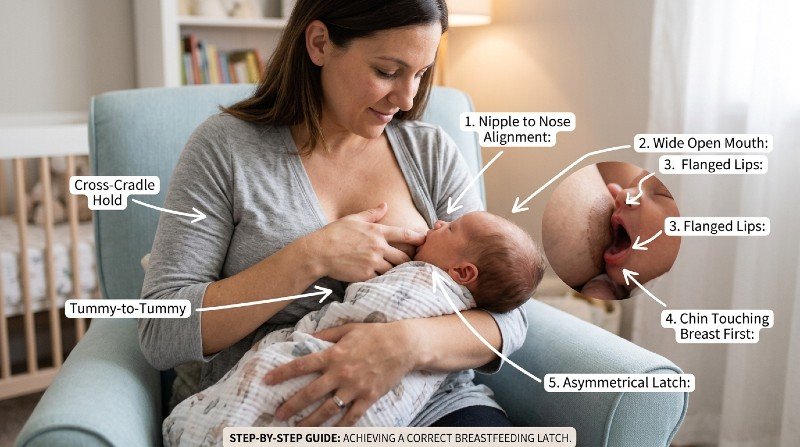
You expected breastfeeding to feel natural. You thought it would just happen. Then your baby arrived and suddenly you were both figuring out something that felt anything but simple. Maybe your nipples are already sore and your baby keeps slipping off. Maybe you’re staring at your phone at 3 am while your little one cries at your chest.
Here’s the first thing to know: you’re not doing it wrong because it’s hard. Breastfeeding is a skill — one that takes practice for both of you. This breastfeeding latch guide walks you through exactly what a correct latch looks and feels like, why it matters more than most people realize, and how to fix common problems when something’s off. You’ve got this.
Why the Latch Is Everything
Almost every major breastfeeding problem traces back to the latch. Nipple pain? Usually latch. Low milk supply? Often latch. Baby not gaining weight well? Frequently latch. Blocked ducts? Can be latch.
When your baby latches correctly, you’re protecting yourself from pain — and you’re sending your body the signal to produce milk efficiently. A shallow or poor latch means your baby is working hard but not getting much. It means your nipple takes a beating it wasn’t designed for.
According to the American Academy of Pediatrics (AAP), proper attachment is one of the most important factors in both breastfeeding success and maternal comfort. Getting the latch right early changes everything — and even if you’re weeks into feeding, it’s never too late to improve it.
What a Correct Latch Actually Looks Like
A correct latch has very recognizable features. Once you know what to look for, you’ll be able to spot problems much faster.
Your baby’s mouth should be wide open. Not just slightly parted — wide, like a yawn. This is the starting position you’re aiming for before bringing baby to breast.
Your baby takes in more than just your nipple. This is the big one. Your baby should have a large portion of your areola — the darker skin around your nipple — inside their mouth. Not just the nipple tip.
Your baby’s lips should be flanged outward. Think fish lips. Both the top and bottom lip turned out, not tucked in.
Your baby’s chin should press into your breast. The chin leads the latch. It should make firm contact with the underside of your breast.
Your baby’s nose should be clear or lightly touching. Many mothers panic when baby’s nose seems close to the breast. But a baby can breathe around a breast. The chin pressing in naturally tips the nose away.
Your nipple should not hurt. Some initial sensitivity in the very first seconds is common. But after that, feeding should be comfortable. Pain is a signal — and it’s worth listening to.

Before You Start: Setting Yourself Up
A good latch starts before your baby even opens their mouth. Positioning yourself and your baby correctly makes everything that follows much easier.
Find a comfortable seat. Your back should be supported. Your arms shouldn’t be straining. Many mothers find a nursing pillow helpful — it brings baby up to breast height and takes weight off your arms.
Bring baby to the breast — not the other way around. Don’t hunch forward toward your baby. Bring your baby up to meet you. Hunching leads to a poor angle, back pain, and a much harder latch.
Make sure baby is tummy-to-tummy with you. Your baby’s entire front should face yours — ear, shoulder, and hip all in a straight line. When baby has to turn their head sideways to reach the breast, swallowing becomes significantly harder.
Support your baby’s neck and shoulders — not the back of the head. Pressing on the back of a baby’s head often causes them to arch away. Support the neck and let them have some natural head movement.
Step-by-Step: How to Get a Deep Latch
Work through these steps at your own pace. Many mothers need several attempts per feeding when they’re first learning — there’s no shame in resetting and trying again.
Step 1: Get comfortable first. Settle into your position before you bring baby up. Have water nearby. Take a breath.
Step 2: Hold your breast if needed. Use a C-hold or U-hold — cupping your breast from underneath to support it. Keep your fingers well back from the areola so they don’t block where baby will latch.
Step 3: Tickle baby’s lips with your nipple. Touch your nipple lightly to your baby’s upper lip and wait for them to open wide. This can take a moment. You’re waiting for that yawn-wide opening.
Step 4: Bring baby to breast when the mouth is wide. The moment you see that wide open mouth, bring your baby in quickly. Aim your nipple toward the roof of their mouth — your baby’s chin should hit your breast first.
Step 5: Check the latch. Are the lips flanged out? Is the chin pressing into the breast? Can you hear soft rhythmic swallowing sounds after a minute or two of quick initial sucks? These are all good signs.
Step 6: If it doesn’t feel right, break the latch and try again. Slide a clean finger gently into the corner of baby’s mouth to release the suction. Then start over. This is completely normal — not a failure.
Signs the Latch Is Working
You don’t have to guess. There are clear signs that breastfeeding is going well.
You feel pulling but not pain. A correct latch feels like firm, comfortable pressure. Not pinching, not burning, not sharp stabbing pain.
You can hear swallowing. In the first few days swallowing may be quiet. As your milk comes in, you should hear clear rhythmic swallows — sometimes even gulping sounds.
Baby’s cheeks stay full and round. Sunken or dimpling cheeks during sucking suggest baby may not have a good seal.
Baby releases the breast looking satisfied. A well-fed baby often falls away from the breast in a milk-drunk state — relaxed, drowsy, content.
Your nipple looks round after feeding. When you unlatch, your nipple should still be roughly the same round shape. If it looks compressed like a new lipstick or has a white line across it, that’s a sign of a shallow latch.
Your baby is gaining weight appropriately. Your provider tracks this. After initial weight loss in the first few days, steady gain back to birth weight and beyond is a reliable indicator that milk transfer is working.
| What You Notice | Likely Deep Latch | Likely Shallow Latch |
|---|---|---|
| Nipple feeling | Gentle pulling sensation | Sharp or pinching pain |
| Baby’s lips | Flanged outward like fish lips | Tucked inward |
| Baby’s cheeks | Full and rounded | Dimpling or sunken |
| Nipple shape after feed | Round and unchanged | Flattened or lipstick shape |
| Swallowing sounds | Rhythmic swallowing heard | Little or no swallowing audible |
Breastfeeding Positions That Help the Latch
The position you choose directly affects how easy or hard a good latch is to achieve. Different positions work better for different mothers and babies — and trying a few different ones early on is genuinely worthwhile.
Cradle Hold
Baby lies across your front, supported by your arm on the same side as the breast being used. Your forearm supports their body and your hand supports their neck. This is the classic nursing position — it works well once breastfeeding is established, though it can be trickier in the early days.
Cross-Cradle Hold
Your opposite arm supports baby instead, with your opposite hand cupping baby’s head and neck. Many lactation consultants recommend this for newborns because it gives you more precise control to guide baby’s head — making that wide latch easier to achieve.
Football Hold
Baby is tucked under your arm with their body along your side and legs pointing behind you. Your hand supports their neck. This is excellent after a C-section because it keeps baby’s weight completely off your abdomen. It also works well if you have larger breasts or a fast letdown.
Side-Lying Position
You and baby both lie on your sides facing each other. Wonderful for night feeds and for recovery from birth when sitting upright is uncomfortable. Takes a little practice to get a good latch in this position, but once you have it, night feeds become significantly less exhausting.
Laid-Back Position
You recline comfortably and let baby lie on your chest. Gravity helps baby stay in position. Many babies instinctively latch well this way — sometimes called biological nurturing. Particularly helpful when you have a fast letdown, since the slightly upright angle slows how quickly milk flows.

When the Latch Hurts: What Might Be Happening
Pain during breastfeeding is common — but common doesn’t mean you should push through it. Pain is useful information.
Shallow latch is the most frequent cause. If baby is only on the nipple tip, every suck compresses the nipple in a way it wasn’t designed for. The fix is breaking the latch and trying again with a wider opening.
Tongue tie is worth knowing about. Some babies have a tight frenulum — the piece of tissue under the tongue — that limits how far the tongue can extend, making a deep latch very difficult. Signs include a clicking sound during feeding, poor weight gain, and significant nipple pain. Ask your provider or lactation consultant to assess for tongue tie if you’re struggling despite trying multiple latch adjustments. According to La Leche League International, tongue tie is an underdiagnosed but very treatable cause of persistent breastfeeding pain.
Nipple pain beyond the first few days deserves attention. Some tenderness in the first week is normal as your nipples adjust. Ongoing pain with every feeding is a signal that something needs to change — see nipple vasospasm and nipple pain for a breakdown of what different types of pain might indicate.
Engorgement can make latching harder. When breasts are very full and firm, it’s harder for baby to get a wide enough latch. Hand expressing or pumping a small amount before feeding softens the areola and makes it much easier for baby to attach.
The Latch and Your Milk Supply: The Connection That Surprises Most Mothers
Here’s something that genuinely surprises many mothers. Your milk supply is directly driven by how effectively your baby removes milk from the breast.
When baby latches shallowly, they transfer less milk. Your breast receives the signal that less milk was needed — and over time, supply can drop.
This is why fixing the latch isn’t just about comfort. It’s about protecting your supply.
According to the Academy of Breastfeeding Medicine (ABM), milk removal efficiency is the primary regulator of milk production. When latch is poor, the downstream effects on supply are documented and significant.
If you have concerns about your milk production, there’s almost always a latch component worth exploring alongside other factors. And if you’re pumping instead of or alongside breastfeeding, our exclusive pumping guide covers how to support supply when the breast pump becomes your primary tool.
Special Situations: When Latching Looks Different
Not every breastfeeding situation looks the same. Some mothers and babies need extra support or different strategies.
Flat or inverted nipples can make initial latching harder. Your nipple doesn’t need to be protruding for breastfeeding to work — but it may take more patience in the early days. A lactation consultant can show you techniques like breast shaping or using a nipple shield temporarily while baby develops a stronger latch.
Premature babies often have a weaker suck reflex and may tire quickly during feeding. They may struggle to coordinate suck-swallow-breathe. This is a developmental stage, not a failure. Work closely with your hospital care team and a lactation consultant throughout.
Babies with high palates can make latching more challenging. This is something a lactation consultant can identify and help you work around with specific positioning adjustments.
After a C-section, positioning matters even more in the early days. The football hold and side-lying position are often most comfortable — they keep all pressure away from your incision while you heal.
Pro Tip: If you’re struggling with latch despite multiple attempts, ask your hospital’s lactation team to observe a full feeding before you go home. Watching you feed in real time gives them information that a quick appointment can’t replicate.
Getting Support: You Don’t Have to Figure This Out Alone
Breastfeeding support is not a luxury — it’s part of your care.
A certified lactation consultant (IBCLC — International Board Certified Lactation Consultant) can observe a full feeding, assess your baby’s mouth structure, evaluate latch in real time, and give you hands-on feedback that no article can fully replicate.
Many hospitals offer lactation support before you go home. Many communities have breastfeeding groups where you can get real-time guidance from trained volunteers. Your OB, midwife, or pediatrician’s office can refer you to resources.
You can find a certified IBCLC near you through the International Lactation Consultant Association (ILCA) directory — one of the most reliable ways to locate qualified professional support.

Don’t wait until you’re in tears at 2 am to ask for help. Reach out at the first sign of struggle. Early support prevents small problems from becoming bigger ones.
Myth vs. Fact
🔍 Breastfeeding: Myths vs. Evidence-Based Facts
Frequently Asked Questions
Every mother and baby pair is different. Some get it within a few days. Others need a few weeks of practice and support. Working with an IBCLC early can shorten that learning curve significantly — most mothers see meaningful improvement after just one guided feeding session.
Yes — you should feel your baby drawing milk. But there shouldn’t be sharp or painful suction. Comfortable, firm drawing is normal. Pain is not.
Some nipple sensitivity in the very first days is common as your body adjusts. But ongoing pain with every feeding is a sign something needs adjusting. Pain is your signal to assess the latch and seek support if needed.
Watch and listen for a pattern: several quick sucks followed by a slower suck and a brief pause. That pause is the swallow. You may also hear a little gulp. As your milk increases, this rhythm becomes clearly audible during most feeds.
Newborns are sleepy — this is completely normal. Try unwrapping them during feeding, tickling their feet, stroking their cheek, or switching sides when they slow down. Keeping baby skin-to-skin during feeding can also help keep them alert and engaged.
Sooner than you think you need to. If feeding is painful beyond the first week, if your baby isn’t gaining weight well, or if you have ongoing supply concerns — contact your provider or an IBCLC promptly. Early support is far more effective than waiting until problems become severe.
Sources
- American Academy of Pediatrics (AAP) — Breastfeeding and the Use of Human Milk
- Academy of Breastfeeding Medicine (ABM) — Clinical Protocols
- La Leche League International — Tongue Tie and Breastfeeding
- International Lactation Consultant Association (ILCA) — Find a Lactation Consultant
- World Health Organization (WHO) — Breastfeeding Recommendations
All information reflects evidence available as of 2026.


