 Skip to content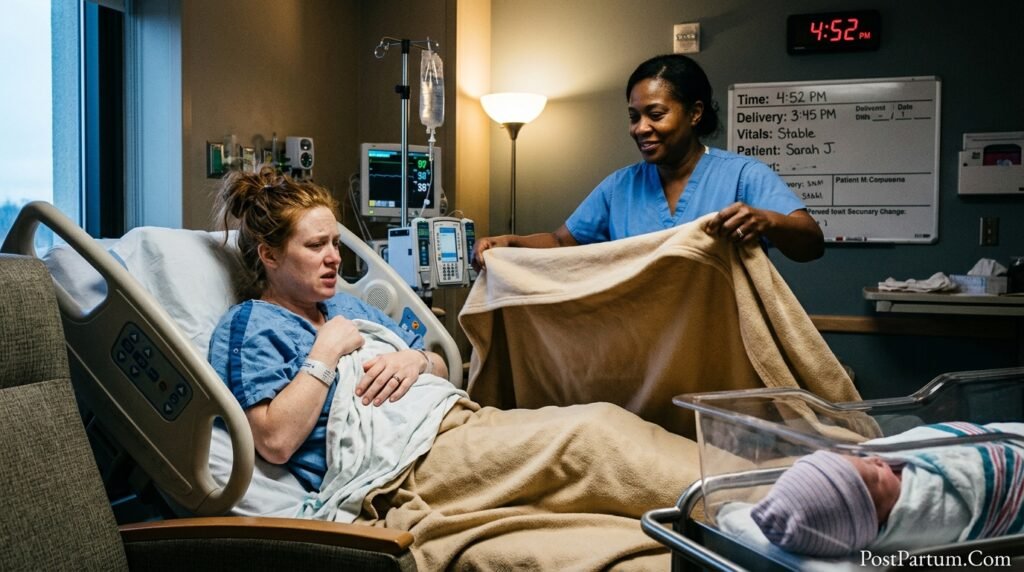
She was lying in the hospital bed an hour after delivery, shaking so hard her teeth were chattering. The baby was healthy. The birth had gone well. She had no idea why her body was trembling like she’d stepped into a freezer.
The nurse walked in, took one look, smiled, and handed her a warm blanket. “Postpartum chills,” she said. “Completely normal. They’ll pass.”
And they did — within about fifteen minutes.
That experience is incredibly common. What’s less common is understanding when shivering and temperature changes after birth are completely ordinary, and when they’re your body sending an urgent message that something is wrong. That distinction matters more than most people realize, because the same symptom — feeling cold, shivering, or running a temperature — can mean either a normal physiological response or the early stage of a serious infection.
Two Very Different Things That Can Both Make You Shake
Normal Postpartum Chills
Postpartum chills is a physiological response that occurs within two hours of childbirth. It appears as uncontrollable shivering, seen in many women after delivery, and can be unpleasant. It lasts for a short time. There is no accompanying fever. A fever would indicate an infection. It is considered a normal response, and reassurance is all that is needed.
What’s happening biologically: Your body just completed one of its most physically intense experiences. The hormonal surge of labor, the massive exertion of pushing, the fluid shifts as pregnancy volume begins equalizing, and the sudden change in body temperature as you go from laboring to resting — all of these converge in the immediate postpartum period and can trigger an intense shivering response from your nervous system.
Think of it as your body momentarily losing its temperature regulation rhythm after an enormous effort. Dr. Russell from Cleveland Clinic describes the feeling as shivering, not really chills — like your teeth are chattering as if you just stepped outdoors into sub-zero weather without a coat. If it feels like that, it’s usually a sign of postpartum chills rather than infection.
Normal postpartum chills:
- Happen within minutes to hours of delivery
- Last roughly 15–30 minutes
- Involve uncontrollable shivering
- Occur with a normal body temperature — no fever
- Resolve with warmth and rest
The Chills That Aren’t Normal
If you feel chills similar to those you have with the flu — an ache that you can almost feel in your bones — you may have a fever, and that could indicate an infection.
This is the critical distinction. Bone-deep aching chills — the kind that feel like the flu, that persist for hours, that don’t respond to a warm blanket — are a different phenomenon entirely. These chills accompany a fever, and a postpartum fever is always something to investigate.
What Postpartum Fever Actually Means
Postpartum fever is defined as an oral temperature of 38°C (100.4°F) on two separate occasions at least 4 hours apart, or above 38.5°C (101.6°F) at any time. This may occur any time from rupture of membranes to 42 days after delivery. Postpartum fever is a sign that requires investigation to determine the specific cause, which will then dictate treatment.
The 42-day window is important. Most new mothers think of infection risk as something limited to the first week after birth. In reality, your vulnerability to certain complications extends through the full sixth week and even beyond.
The most common causes of postpartum fever — and how to recognize each:
Endometritis (uterine infection) — Endometritis usually appears 2 to 3 days after delivery and accounts for over half of postpartum infections. Symptoms include fever, uterine tenderness, and foul-smelling lochia. Your lower abdomen feels sore to the touch, your postpartum bleeding smells wrong, and you have a temperature. This is the most common postpartum infection and it requires antibiotics.
Urinary tract infection — Women are more vulnerable to UTIs after delivery, especially if they had a catheter in their bladder. Symptoms include fever, difficulty urinating, painful urination, the feeling of needing to urinate often and urgently but little or nothing coming out, or urine that is cloudy or bloody.
Mastitis — This breast infection affects as many as 1 in 10 nursing mothers and is more likely in moms with cracked nipples. It ranges in severity from a red and warm irritation to a flu-like infection. Symptoms include a painful, hard, warm, red area on one breast alongside fever, chills, muscle aches, fatigue, or a headache.
Wound infection — Cesarean incision or perineal repair sites can become infected. Look for redness spreading outward from the wound, swelling that’s increasing, warmth, discharge, or wound edges separating.
A Symptom Comparison That Could Save You a Late-Night Spiral
You woke up feeling cold and shaky at 2 am. Here’s how to think about what’s happening.
| Question to Ask Yourself | If the Answer Is… | What It Likely Means |
|---|---|---|
| When did this start? | Within hours of delivery, or first few days | Likely normal postpartum shivering |
| Does a warm blanket help? | Yes — shivering settled within 15–30 min | Normal physiological response |
| What does your thermometer say? | 97°F–99°F (36.1°C–37.2°C) — normal range | Normal chills, not fever |
| What does your thermometer say? | 100.4°F (38°C) or above | Call your doctor |
| Do the chills feel like bone-deep flu aches? | Yes — with body aches and not going away | Possible infection — call your doctor |
| Any breast pain or redness? | Yes, one breast hot and hard | Possible mastitis — call your doctor |
| Any pelvic pain or foul-smelling discharge? | Yes | Possible endometritis — call your doctor |
| Any burning when you urinate? | Yes | Possible UTI — call your doctor |
Keep a thermometer in your bedroom during the postpartum period. It takes ten seconds to use and removes all the guessing.

Night Sweats vs. Night Chills: Both Common, Different Causes
Many new mothers experience night sweats and night chills in the same postpartum period — sometimes alternating in the same night. These are related but distinct experiences.
Night sweats happen as your body offloads the extra fluid it accumulated during pregnancy. Your blood volume increased by roughly 50% during pregnancy. Once the baby arrives, your body eliminates that excess through sweat — particularly at night. This is normal, hormonally driven, and most intense in the first one to two weeks. Our article on postpartum hot flashes and temperature changes explains the mechanism in detail.
Night chills and shivering in the postpartum period can be:
- The immediate post-delivery physiological response (hours after birth)
- Hormonal temperature dysregulation as estrogen levels drop
- A response to breastfeeding — the oxytocin release with feeding may create temporary temperature shifts and shivering that rapidly resolve.
- An early warning sign of infection if accompanied by fever
The pattern and temperature reading distinguish which you’re dealing with.
Endometritis: The Infection Most Women Don’t Know By Name
Endometritis, an infection of the uterine lining, in the postpartum period typically presents with abdominal pain, fever, and chills. Endometritis affects approximately 1–3% of vaginal deliveries and up to 27% of cesarean deliveries.
That C-section figure is striking. More than one in four cesarean deliveries can result in endometritis without appropriate prevention and monitoring. Women who have had a cesarean are at significantly higher risk and need to be vigilant during the first week in particular.
Signs of endometritis that go beyond ordinary postpartum discomfort:
- Uterine tenderness when you press on your lower abdomen — not just general cramping but pain on palpation
- Lochia that smells distinctly foul or different from normal postpartum discharge
- Fever, especially appearing two to three days after delivery
- Chills that feel like flu rather than postpartum shivers
Postpartum chills can surprise many new moms, sometimes starting right in the delivery room. Most of the time, postpartum chills are not dangerous — they’re a natural response to the intense physical and hormonal changes during childbirth. However, if you notice chills along with fever, feeling unwell, or other unusual symptoms, it’s best to reach out to your doctor.
When You Must Call — Not Wait, Not Wonder
March of Dimes puts it plainly: “Too many new moms die from health problems that could have been prevented by getting the right postpartum care.” They list fever higher than 100.4°F as a top warning sign requiring immediate contact with your provider.
Call your doctor or midwife without delay if:
- Your temperature is 100.4°F (38°C) or above at any point in the first six weeks
- Chills feel like deep flu aches — not just surface shivering — and they aren’t resolving
- You have any breast that is hard, red, and hot alongside chills
- Postpartum bleeding smells foul or changes character
- You have pain or burning when urinating plus a fever
- Your C-section incision or perineal stitches show spreading redness, pus, or warmth
Go directly to the emergency room if:
- Your temperature is above 103°F (39.4°C)
- You have a rapid heartbeat, confusion, or difficulty breathing alongside fever — these can indicate sepsis, a life-threatening emergency
- Bleeding is heavy and worsening at the same time as you have a temperature
- You feel genuinely, seriously unwell in a way that feels beyond ordinary postpartum fatigue
Signs and symptoms of postpartum infections usually include a fever greater than 38.0°C (100.4°F), chills, lower abdominal pain, and possibly odorous vaginal discharge. Infections usually occur after the first 24 hours and within the first ten days following delivery. That ten-day window is when your risk is highest — but your vigilance needs to extend through six weeks.

Postpartum Fever After Discharge: Don’t Assume It’s Fine
One of the most dangerous patterns in postpartum complications is the mother who developed an infection after going home from the hospital, minimized her symptoms, and waited too long to seek care. You’re managing a newborn. You’re exhausted. You don’t want to be an inconvenience. You tell yourself it’s probably fine.
Infections caught in the first 24–48 hours of symptoms are straightforward to treat with antibiotics. Infections allowed to progress for three to five days can require hospitalization, IV antibiotics, or more complex intervention.
The math strongly favors calling too early.
Our comprehensive guide to postpartum infection symptoms covers each infection type in detail — endometritis, mastitis, UTI, and wound infection — with specific symptom checklists for each. Reading it before you need it means you’ll recognize warning signs faster when they appear.
What Normal Postpartum Temperature Fluctuation Looks Like
Not every temperature change is alarming. Your body is actively recalibrating across many systems during the fourth trimester. What’s worth monitoring:
- A mild temperature of 99°F–100°F (37.2°C–37.8°C) on day one or two, in the absence of other symptoms, can reflect the normal exertion of labor and delivery. Monitor it — but a single reading in this range isn’t automatically cause for panic.
- The formal definition of concerning postpartum fever is 100.4°F on two separate occasions at least 4 hours apart, or above 101.6°F at any single reading. This is the clinical threshold that warrants investigation.
- Temperature above 100.4°F with any other symptom — pain, unusual bleeding, foul odor, breast changes — should prompt an immediate call regardless of the “two readings” rule.
And a reminder: normal chills in the delivery room or first hours postpartum should not register as a fever on your thermometer. That’s the most reliable way to distinguish them.
Connecting the Dots: Fatigue, Immunity, and Why Infections Hit Now
Severe exhaustion from sleep disturbance compromises your immune system. When you’re operating on little sleep while your body recuperates from giving birth, shaking spells are increasingly probable — and your immune defenses are genuinely lowered.
This is why the postpartum period carries elevated infection risk beyond just the wound sites. Your immune system is stretched, your cervix is still partially open for several weeks, your body is managing multiple simultaneous repair processes, and you’re likely not sleeping adequately.
Protecting yourself includes things that feel unrelated to infection risk: eating protein consistently, staying hydrated, accepting help so you can rest, and attending all your postpartum appointments even when you feel fine. Our guide on building your postpartum village is essentially a guide to keeping your immune defenses as strong as possible during a period when they’re under pressure.
A Word on Postpartum Mood and Unexplained Physical Symptoms
Some women experience physical symptoms — including shivering, temperature sensitivity, and general unwellness — as part of postpartum anxiety or panic attacks rather than infection. A panic attack can produce physical symptoms including rapid heartbeat, feeling of cold, and trembling. Postpartum anxiety affects up to 20% of new mothers and can manifest with intensely physical sensations.
The way to distinguish: take your temperature. Anxiety and panic don’t produce a fever. If your temperature is normal, the symptoms may be anxiety-related rather than infection-related — and both deserve attention, just different kinds.
Quick Reference: The Thermometer Rule
Print this. Put it near your bed.
| Reading | Action |
|---|---|
| Below 99°F (37.2°C) | Normal. Monitor if symptoms develop. Rest and hydrate. |
| 99°F–100.3°F (37.2°C–37.9°C) | Low grade. Recheck in 2 hours. Call if it rises, or if you feel unwell. |
| 100.4°F (38°C) or above | Call your doctor or midwife now. Don’t wait for morning. |
| 101.6°F (38.5°C) or above at any reading | Call immediately — urgent evaluation needed. |
| 103°F (39.4°C) or above | Emergency room or call emergency services. |
| Any temperature with chest pain, confusion, or rapid breathing | Emergency — call 000/999/911 immediately. |

Frequently Asked Questions
Your nurse or midwife would have taken your temperature to confirm there was no fever. If your temperature was normal and the shivering resolved, that’s textbook postpartum chills — physiological, normal, and self-resolving. Always mention any shivering to your care team so they can confirm your temperature; they expect it and won’t be bothered by the question.
The clinical monitoring period extends to 42 days (six weeks) after delivery. Most infections appear in the first ten days, but endometritis, UTIs, wound infections, and mastitis can all develop beyond the two-week mark. Mastitis in particular commonly occurs three to four weeks postpartum.
No. Fever that responds to ibuprofen or acetaminophen is still a fever that needs evaluation. These medications lower your temperature temporarily but don’t treat the underlying cause. Contact your provider even if the fever came down with medication.
Night sweats without fever are most commonly the normal hormonal and fluid-offloading process of early postpartum recovery. They’re uncomfortable but not a warning sign on their own. If sweats are accompanied by a temperature, breast changes, foul-smelling discharge, or other symptoms, that combination warrants a call.
Chills appearing in the first days after birth during delivery-room recovery are classic normal postpartum chills. Chills appearing at day five, day ten, or three weeks postpartum — especially with fever and other symptoms — are more likely to indicate infection than normal physiology. Any chills paired with fever at any point in the six-week postpartum period deserve a call to your provider.
Sources
- 5-Minute Clinical Consult (Wolters Kluwer, 2026) — Postpartum Fever
- Cleveland Clinic — Intense Shivering After Your Baby’s Born: Postpartum Chills
- March of Dimes — Warning Signs of Postpartum Health Problems
- Momminess — Postpartum Chills: When to Worry and When It’s Normal, March 3, 2026
- Momcozy — Postpartum Chills After 1 Week: What You Need to Know
- Lakeside Doctors OB-GYN — Postpartum Fever
- Wikipedia — Postpartum Chills / Postpartum Infections
- American College of Obstetricians and Gynecologists (ACOG) — Postpartum Care
All information reflects evidence available as of 2026.


