...

Editor's Choice

Postpartum Hair Loss: When Does It Start and How Long Does It Last?

Three months after my daughter was born, I stood in the shower watching what seemed like half my hair swirl down the drain. I remember calling my sister in tears, convinced something was seriously wrong with me. She laughed—not unkindly—and said, “Welcome to the postpartum hair loss club. Mine lasted six months.”

She was right. And she wasn’t alone.

Nearly half of all new mothers will experience this frustrating, often alarming phase of excessive hair shedding. You spent nine months growing a human, survived childbirth, and now you’re navigating sleepless nights and endless diaper changes. The last thing you need is to watch your hair fall out in clumps every time you brush it.

But here’s what I’ve learned through both personal experience and years of researching maternal health: postpartum hair loss is temporary, predictable, and—most importantly—not a sign that something’s wrong with you.

ℹ️ Medical Disclaimer:

This article provides research-backed information about postpartum hair loss but does not substitute for professional medical advice. If you’re experiencing sudden patchy baldness, scalp pain, or shedding that continues beyond 15 months postpartum, consult your healthcare provider. These symptoms may indicate thyroid issues or nutritional deficiencies that require medical treatment.

⚠️ Seek medical attention if: You experience sudden patchy hair loss, persistent scalp pain, unusual fatigue, unexplained weight changes, or hair shedding that doesn’t improve after 15 months postpartum.

What You Need to Know Right Now

  • Postpartum hair shedding typically starts between 2-4 months after delivery (with month 3 being most common)
  • The worst shedding usually happens around month 4-5, then gradually improves
  • Most women see their hair return to normal by their baby’s first birthday
  • This happens because of plummeting estrogen levels, not because you’re doing anything wrong
  • Your hair follicles aren’t damaged—you’re just shedding the extra hair you retained during pregnancy

Why Your Hair Loved Pregnancy (And Why It’s Leaving Now)

Let me explain what’s actually happening inside your hair follicles, because understanding this process helped me worry less when I was going through it.

Your hair grows in cycles. Normally, about 85-90% of your scalp hair is actively growing at any given time, while the remaining 10-15% is resting before it falls out. On a regular day, you lose 50-100 hairs. You probably never noticed because new hairs were constantly replacing them.

During pregnancy, elevated estrogen levels essentially hit the “pause” button on normal hair shedding. Those hairs that would have naturally fallen out? They stuck around instead. This is why many women rave about their thick, lustrous pregnancy hair. You weren’t actually growing more hair—you were just losing less.

Then you give birth.

Within 24-48 hours, your estrogen levels crash back to pre-pregnancy levels. All those hairs that were supposed to fall out over the past nine months suddenly get the green light to shed. But there’s a delay—it takes about 2-4 months for those hairs to transition through their final phase and actually fall out.

That’s why you don’t notice significant shedding immediately after delivery. The hair loss you experience at 3-4 months postpartum is actually your body catching up on nine months’ worth of normal shedding that didn’t happen during pregnancy.

Here’s the medical term: telogen effluvium. It sounds scary, but it simply means “resting phase hair loss.” And it’s completely reversible.

When Does Postpartum Hair Loss Actually Start?

Based on what I’ve seen in support groups, talked about with my OB-GYN colleagues, and experienced myself, here’s the realistic timeline:

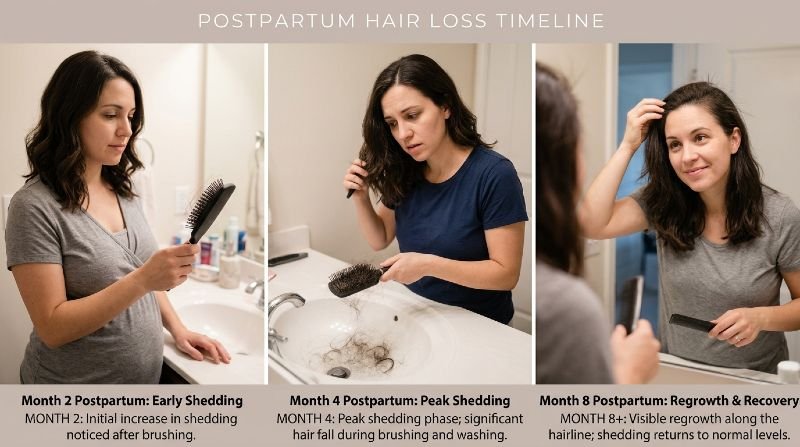
Weeks 1-8: You might still have that great pregnancy hair. Some women notice their hair texture changes (less oily, different curl pattern), but actual shedding hasn’t ramped up yet. Enjoy this while it lasts.

Weeks 8-12: This is when most women first notice something’s off. You might see more hair in your brush or a few extra strands on your pillow. It’s not dramatic yet, but it’s noticeable.

Weeks 12-20: Peak shedding time. I recommend keeping a hair tie on your wrist during this phase because you’ll want to pull your hair back often. Loose hair everywhere becomes the norm—on your clothes, the baby’s hands, your partner’s shirts, the couch. One mother I know kept finding her hair wrapped around her baby’s toes (which, by the way, can be dangerous—always check those tiny toes).

Months 5-6: Shedding usually starts to slow down. You’re probably still losing more than normal, but it’s not as alarming as month 4 was.

I’ve noticed the timing can vary based on a few factors. Women who had particularly thick hair during pregnancy sometimes report more dramatic shedding. C-section versus vaginal delivery doesn’t seem to make much difference, despite what some online forums claim.

Here’s something that surprised me: breastfeeding doesn’t meaningfully delay or worsen postpartum hair loss. Recent studies tracking hundreds of new mothers have found very similar shedding patterns regardless of feeding method. So if someone tells you to stop breastfeeding to save your hair, you can safely ignore that advice.

How Long Does This Nightmare Last?

The question every woman asks. I asked it too.

For most women—and I mean about 85-90% based on recent research—the active shedding phase lasts 3-6 months total. So if it starts at month 3 postpartum, you’re usually seeing significant improvement by month 6-9.

Your hair doesn’t return overnight, though. That was my biggest misconception. I kept expecting to wake up one day with my pre-pregnancy hair back. Instead, recovery happens gradually:

Month 6-8: Shedding decreases to near-normal levels. You start seeing little “baby hairs” sprouting along your hairline. These short, wispy hairs can be annoying (they stick straight up and refuse to cooperate with any hairstyle), but they’re a good sign.

Month 9-12: New growth continues. Your hair density starts looking more normal, though you might notice these new hairs are finer or have a different texture than your original hair.

Month 12-15: Most women report their hair has returned to pre-pregnancy fullness. Some notice permanent changes in texture (curlier or straighter than before), but volume is restored.

I’ll be honest with you—my hair took a full 14 months to feel “normal” again. And even then, my hairline looked different. Those baby hairs eventually grew out, but it took patience.

A small percentage of women (about 10-15%) experience shedding that continues beyond 12 months or hair that never quite returns to its previous density. This is where medical evaluation becomes important, because extended hair loss can signal thyroid problems or iron deficiency rather than normal postpartum changes.

Four-panel grid showing same woman’s hairline at month 2 (full), month 4 (thinning visible), month 7 (baby hairs emerging), month 12 (full recovery), consistent lighting and angle
Most postpartum hair loss follows a predictable pattern: peak around month 4–5, regrowth by month 7, and near-full recovery by month 12.

Real Stories: What This Actually Looks Like

Maya, 32, first-time mom: “I didn’t believe my friends when they warned me. At 14 weeks postpartum, I woke up to find hair all over my pillow—not just a few strands, but actual clumps. I took a photo and sent it to my midwife in a panic. She reassured me it was normal, but I cried anyway. The worst part was the bald spots developing around my temples. I started wearing headbands daily to hide them. Around month 8, I noticed the shedding slowing down. By my daughter’s first birthday, I had a ‘halo’ of new growth that stuck straight up, which was almost as frustrating as the hair loss itself.”

Jasmine, 28, second baby: “With my first, the hair loss was moderate and didn’t bother me much. With my second, it was so much worse. I think the stress of managing a toddler while caring for a newborn affected things. My ponytail was literally half its normal thickness. What helped me was getting a shorter haircut at month 5—it made the shedding less visible and made me feel more in control.”

Rebecca, 35, twins: “Nobody warned me that having twins might mean worse hair loss. Between months 3 and 6, I was convinced I was going bald. My part got so wide I could see scalp. My doctor tested my thyroid and iron levels, which came back normal. She explained that the higher hormone levels from carrying twins might have meant more hair retention during pregnancy, so I had more to lose afterward. She was right—by month 10, my hair bounced back completely.”

These stories illustrate an important point: everyone’s experience varies, but the pattern remains consistent. Start date, peak shedding, gradual recovery.

Is This Normal Hair Loss or Something More Serious?

This is where I want you to pay attention, because while most postpartum hair loss is benign, sometimes it signals a medical issue that needs treatment.

Normal Postpartum Shedding Looks Like:

  • Hair falling out evenly across your entire scalp
  • Noticeable thinning at the temples and along your hairline (this area seems to get hit hardest)
  • Shedding that starts 2-5 months after delivery
  • No other scalp symptoms—no pain, itching, redness, or flaking
  • Gradual improvement after peak shedding around month 4-5

Warning Signs That Need Medical Evaluation:

  • Round, coin-sized bald patches (this suggests alopecia areata, an autoimmune condition)
  • Hair loss that starts within days of delivery or begins after 6 months postpartum
  • Extreme, sudden shedding that happens over just a few days
  • Scalp that’s painful, red, itchy, or scaly
  • Hair that breaks off rather than falling out from the root
  • Shedding that continues full-force beyond 12 months

I can’t stress this enough: if you’re experiencing other postpartum symptoms alongside hair loss—extreme fatigue, unexplained weight changes, feeling cold all the time, heart racing, mood swings beyond normal postpartum adjustment—get your thyroid checked.

Postpartum thyroiditis affects 5-10% of new mothers and often appears 2-6 months after delivery, the same timeframe as normal hair loss. The difference is that thyroid-related hair loss comes with other symptoms and doesn’t improve on its own.

Side-by-side comparison infographic showing diffuse normal postpartum hair thinning versus circular alopecia patches and inflamed scalp conditions
Diffuse thinning across the scalp is typical postpartum shedding. Circular bald patches or inflamed scalp areas require medical evaluation.

What Actually Helps (And What’s Just Marketing)

I wasted money on so many products during my postpartum hair loss phase. Let me save you the trouble.

What the Research Actually Supports:

Gentle Hair Handling

This won’t stop hormonal shedding, but it prevents additional breakage. I learned this the hard way after a particularly aggressive brushing session left me near tears.

  • Switch to a wide-toothed comb during peak shedding months
  • Detangle starting from the ends, working up to roots
  • Skip the tight ponytails—I know it’s tempting when you’re covered in spit-up, but traction makes things worse
  • Limit heat styling to once a week maximum
  • Be gentle when towel-drying (pat, don’t rub)

Nutrition That Matters

Your body just performed an incredible feat. It needs proper fuel to recover, including rebuilding hair.

Protein is critical because hair is made of keratin protein. If you’re breastfeeding, you need about 71 grams daily. That’s roughly:

  • 3 oz chicken breast (26g)
  • 1 cup Greek yogurt (20g)
  • 2 eggs (12g)
  • 1/4 cup almonds (8g)
  • 1 cup cooked lentils (18g)

Iron matters more than most people realize. Recent studies indicate that women with ferritin (stored iron) levels below 40 ng/mL often experience longer recovery times from postpartum hair loss, underscoring the importance of checking iron stores in persistent shedding.

If you had significant bleeding during delivery or you’re feeling exhausted beyond normal new-parent tired, ask your doctor to check your ferritin specifically—not just hemoglobin. Standard anemia tests can miss iron depletion.

Good iron sources include:

  • Red meat (most easily absorbed)
  • Spinach and dark leafy greens (pair with vitamin C for better absorption)
  • Fortified cereals
  • Beans and lentils

Scalp Care

Here’s something that actually helped me: regular scalp massage. Five minutes while I watched TV with the baby asleep on my chest. A 2025 study of postpartum women found that daily scalp massage modestly improved regrowth speed, though total recovery time remained similar.

The massage doesn’t stop shedding, but it increases blood flow to follicles and honestly felt relaxing during a stressful time.

What Probably Won’t Help:

Biotin Supplements

Every influencer seems to push biotin for hair growth. Here’s the truth: biotin only helps if you’re actually biotin deficient, which is extremely rare. Most of us get plenty from normal food.

Worse, high-dose biotin (those 5,000-10,000 mcg gummies) can interfere with lab tests, including thyroid tests. If you’re getting bloodwork done, stop biotin supplements at least 48 hours before.

“Hair Growth” Shampoos

I bought three different brands. None made any difference. Most contain ingredients like caffeine or biotin that might theoretically stimulate follicles, but they rinse off before they can have any real effect.

Save your money. A gentle, sulfate-free shampoo works just as well.

Collagen Supplements

The research here is mixed at best. Your body breaks down collagen into amino acids during digestion anyway. You’re better off eating a balanced diet with adequate protein.

Should You Try Medical Treatments?

Minoxidil (Rogaine)

This FDA-approved treatment actually works for hair regrowth—but here’s the catch: most dermatologists don’t recommend it for normal postpartum hair loss because the condition resolves on its own.

If you’re breastfeeding, minoxidil is not recommended due to potential infant exposure. Even after weaning, you’d need to use it continuously or your results would reverse.

I considered it around month 6 when I was desperate, but my dermatologist talked me out of it. “Give it until month 9,” she said. “Most women see natural improvement by then.” She was right.

Low-Level Laser Therapy (LLLT)

This is newer territory. FDA-cleared LED caps and combs hit the market in 2024-2025, claiming to stimulate follicles with specific light wavelengths.

The evidence for androgenic alopecia (genetic hair loss) is moderately positive. For postpartum telogen effluvium? Not enough research yet. These devices also cost $200-$800, which seems excessive for a temporary condition.

Platelet-Rich Plasma (PRP) Injections

Some dermatology practices offer this: they draw your blood, concentrate the platelets, and inject them into your scalp. The growth factors supposedly stimulate follicles.

Here’s my take: PRP shows promise for certain types of hair loss, but using it for self-limiting postpartum shedding is like using a sledgehammer to hang a picture frame. It’s expensive ($500-$1,500 per session, typically 3-6 sessions needed), and you’ll probably recover just as quickly without it.

Practical Strategies That Actually Made a Difference

Beyond the medical side, here’s what helped me cope during those frustrating months:

Style Adaptations

Get a strategic haircut. Around month 5, I cut my shoulder-length hair to a long bob. Shorter hair made the shedding less visually overwhelming, and styling took less effort.

Embrace the side part. Center parts emphasize thinning. A deep side part disguises it better.

Dry shampoo is your friend. Not just for oil control—the texture it adds makes hair look fuller. I used it on non-wash days around my hairline.

Headbands and hair accessories. They covered my thinning temples and made me feel more pulled together during those months when I barely had time to shower.

Mental Health Matters

The emotional impact of postpartum hair loss doesn’t get discussed enough. I felt vain for caring when I had a healthy baby, but your feelings are valid.

If hair loss is significantly affecting your mood—especially if you’re also experiencing subtle signs of postpartum depression—tell your healthcare provider. Your emotional wellbeing matters just as much as your physical recovery.

I found it helpful to:

  • Join online support groups where other women were going through the same thing
  • Keep a “progress photo” at peak shedding to compare against later (seeing visible improvement helped)
  • Remind myself daily that this was temporary
  • Talk openly with my partner about how I was feeling instead of suffering silently

What to Expect During Regrowth

Around month 7, I noticed something new: dozens of short hairs sticking straight up around my forehead. They looked ridiculous. I couldn’t tuck them behind my ears or smooth them down. They had a mind of their own.

These “baby hairs” signal that your follicles are recovering. New hairs emerge and start the slow process of growing to match your existing hair length.

Hair grows approximately 0.5 inches per month, so those tiny sprouts need 6-12 months to blend in with your regular hair. In the meantime:

Use a small amount of gel or pomade to smooth flyaways when needed. I kept a travel-size container in my diaper bag.

Consider hair texture. Many women report that regrowth comes in with a different texture—curlier, straighter, coarser, or finer than before. This usually normalizes over time, but sometimes the change is permanent. My regrowth was noticeably wavier than my original hair.

Be patient with the process. By month 12-15, most women can’t tell where the new growth ends and old hair begins. But getting there requires patience, which is admittedly hard when you’re sleep-deprived and covered in baby drool.

When Months Pass and Hair Isn’t Recovering

Most information stops at “it’ll get better by 12 months,” but what if it doesn’t?

About 10-15% of women experience continued thinning or incomplete recovery. This warrants medical investigation because several conditions can masquerade as or compound postpartum hair loss:

Thyroid Dysfunction

Postpartum thyroiditis often goes undiagnosed because symptoms overlap with normal postpartum exhaustion. The condition typically causes temporary hyperthyroidism (too much thyroid hormone) followed by hypothyroidism (too little).

Hair loss from hypothyroidism continues indefinitely until treated. If you’re experiencing:

  • Persistent fatigue despite adequate sleep
  • Unexplained weight gain or inability to lose pregnancy weight
  • Feeling cold when others are comfortable
  • Constipation
  • Brain fog or difficulty concentrating

Request a full thyroid panel: TSH, Free T4, and Free T3. TSH alone can miss subclinical issues.

Iron Deficiency

This is especially common if you experienced postpartum hemorrhage or have heavy periods returning. Iron deficiency can trigger telogen effluvium independent of hormonal causes.

Ask for ferritin testing, not just hemoglobin. Ferritin below 40 ng/mL can affect hair regrowth even when hemoglobin is technically normal.

Vitamin D Deficiency

Emerging research suggests vitamin D receptors play a role in hair follicle cycling. A 2026 study found that postpartum women with vitamin D levels below 20 ng/mL had slower hair recovery compared to those with optimal levels (around 30–50 ng/mL).

Chronic Stress

Your body just went through massive changes. If you’re dealing with a colicky baby, postpartum rage, sleep deprivation, or major life stressors, chronic cortisol elevation can prolong telogen effluvium.

This isn’t your fault, and it doesn’t mean you’re weak. Stress-related hair loss is physiological. Finding support—whether through therapy, family help, or support groups—can make a real difference.

The 2026 Landscape: New Tools and Research

AI-Powered Scalp Analysis Apps

Several companies launched smartphone apps in 2025-2026 that use AI to analyze scalp photos and track hair density over time. I tested one called “HairMetrics” during my research.

You take standardized photos every 2-4 weeks, and the app measures hair count, density, and regrowth in specific zones. The objective data helped reduce my anxiety about normal day-to-day shedding variation.

These apps cost $5-15 monthly and can provide reassurance during recovery. Just remember they’re tracking tools, not diagnostic devices.

Postpartum-Specific Nutritional Formulas

Multiple supplement companies released “postpartum hair recovery” products in 2025-2026. Most contain combinations of biotin, collagen, iron, and various vitamins.

Here’s my honest assessment: if you have documented deficiencies, targeted supplementation helps. If you’re already getting adequate nutrition, proprietary blends won’t accelerate hormonal recovery. Many of these products cost $40-60 monthly—money better spent on quality food or a good haircut.

Microbiome Research

This is genuinely exciting. Preliminary 2026 research suggests that scalp microbiome composition may influence inflammation around follicles and affect regrowth signaling.

We’re not at the point of clinical applications yet, but within a few years, we might see probiotic scalp treatments specifically formulated for postpartum recovery.

Comparing Your Options: What Makes Sense?

Approach Evidence Level Cost Recommended For
Gentle hair care practices Strong – prevents additional damage Free – $20 Everyone experiencing postpartum shedding
Optimized nutrition Strong – supports recovery if deficient $0-50/month All postpartum women, especially those with confirmed deficiencies
Scalp massage Moderate – may modestly improve regrowth speed Free Anyone wanting a low-risk intervention
Biotin supplements Weak – only helps if deficient (rare) $10-25/month Not recommended unless deficiency confirmed
Minoxidil (Rogaine) Strong for hair growth, not typically needed for postpartum shedding $15-40/month ongoing Women with hair loss persisting beyond 12-15 months after other causes ruled out
Low-level laser therapy Weak for postpartum – emerging research $200-800 device Not recommended as first-line for temporary postpartum shedding
PRP injections Weak for postpartum – designed for other hair loss types $1,500-4,500 for full series Not recommended for self-limiting postpartum telogen effluvium
💆

Scalp massage

🔬 Evidence Level: Moderate – may modestly improve regrowth speed
💰 Cost: Free
💊

Biotin supplements

🔬 Evidence Level: Weak – only helps if deficient (rare)
💰 Cost: $10-25/month
💧

Minoxidil (Rogaine)

🔬 Evidence Level: Strong for hair growth, not typically needed for postpartum shedding
💰 Cost: $15-40/month ongoing

Living Through It: A Month-by-Month Action Plan

Here’s what I wish someone had given me—a concrete plan for each phase:

Months 1-2 Postpartum (Before Shedding Starts)

  • Focus on postpartum recovery and bonding with baby
  • Start taking a postnatal vitamin if you’re not already
  • If you experienced significant blood loss during delivery, ask your doctor about iron supplementation
  • Consider cutting hair shorter now if you’ve been thinking about it—easier than dealing with long hair later

Month 3 (Shedding Typically Begins)

  • Don’t panic when you notice increased shedding—this is expected
  • Switch to gentle hair care practices now
  • Take a baseline photo of your hairline/part for comparison later
  • If you notice night sweats or other concerning symptoms alongside hair loss, mention this to your provider

Months 4-5 (Peak Shedding)

  • This is the hardest phase mentally—find support if you need it
  • Consider a hairstyle change to make shedding less visible
  • Avoid comparing your timeline to others—recovery varies
  • If you’re also struggling with mood changes, don’t hesitate to discuss this with your healthcare provider

Months 6-8 (Shedding Should Be Tapering)

  • Look for baby hairs emerging along hairline—a positive sign
  • If shedding hasn’t decreased at all, schedule a checkup to rule out thyroid or iron issues
  • Keep up with gentle hair care even as you see improvement

Months 9-12 (Recovery Phase)

  • Most women see significant improvement during this window
  • Be patient with short regrowth—it takes time to blend in
  • If hair hasn’t noticeably improved by month 12, medical evaluation is appropriate

Beyond Month 12

  • If significant shedding continues or hair hasn’t started recovering, comprehensive testing is needed
  • This doesn’t mean something’s seriously wrong, but it does mean your body needs more support

Frequently Asked Questions

My sister’s hair fell out worse with her second baby. Will mine too?

Experiences vary by pregnancy. Some women report similar patterns with each baby, while others notice differences based on stress levels, nutritional status, or hormonal variations between pregnancies. There’s no way to predict your pattern based on family members’ experiences. I had friends whose hair barely shed with their first but experienced significant loss with their second, and vice versa.

I’m losing eyebrow and body hair too. Is this still normal postpartum shedding?

Postpartum telogen effluvium primarily affects scalp hair. If you’re noticing significant loss of eyebrows, eyelashes, or body hair, this suggests a different issue—most likely thyroid dysfunction. Schedule an appointment with your healthcare provider for thyroid testing. This pattern needs evaluation beyond normal postpartum changes.

Can I get highlights or a keratin treatment while experiencing postpartum hair loss?

Chemical treatments won’t worsen the underlying hormonal shedding, but they can increase breakage of already fragile hair. If you decide to proceed, work with a stylist experienced in damaged or thinning hair, and use gentle formulations. Many stylists recommend waiting until shedding stabilizes, but this is a personal choice. I got highlights around month 8 and didn’t notice any problems.

My healthcare provider dismissed my concerns and said it’s “just cosmetic.” What should I do?

While postpartum hair loss doesn’t threaten your physical health, your emotional wellbeing matters. If hair loss is significantly affecting your quality of life or mental health, you deserve to be heard. Consider seeking a second opinion, or specifically request testing to rule out thyroid dysfunction and iron deficiency. Sometimes you need to advocate firmly for yourself, especially if you’re experiencing other symptoms beyond hair loss.

I’m 8 months postpartum and my shedding just started. Is something wrong?

Late-onset shedding (beginning after 6 months postpartum) falls outside the typical pattern and warrants medical evaluation. This timing suggests a cause other than normal postpartum hormonal changes—potentially thyroid issues, iron deficiency, or stress-related telogen effluvium. Schedule an appointment with your provider for bloodwork before assuming this is normal postpartum shedding.

Will wearing my hair up constantly make it fall out more?

Tight hairstyles create traction on follicles, which can worsen shedding and cause additional hair loss called traction alopecia. Loose ponytails and buns are fine, but avoid styles that pull tightly on your hairline. I rotated between loose styles and wearing my hair down to minimize stress on follicles. If you need your hair up (which I totally understand with a baby grabbing everything), use soft scrunchies instead of tight elastics.

Moving Forward: You’ll Get Through This

Sitting here writing this with my daughter now three years old, I barely remember those months of watching my hair fall out. But I vividly remember how distressing it felt at the time.

Your hair will recover. Those clumps in the shower drain are temporary. The widening part will fill back in. Those ridiculous baby hairs sticking up will eventually grow long enough to behave.

This is one of many changes your body navigates after pregnancy—some visible, others not. It doesn’t diminish the incredible feat you accomplished or your identity as a mother.

Focus on what you can control: gentle hair care, good nutrition, adequate rest when possible (I know, easier said than done with a baby). Let go of what you can’t: the timeline, the comparison to other women, the hormones driving this process.

And if you find yourself six months from now with baby hairs sprouting everywhere and a full head of recovering hair, remember that new mother who was worried it would never come back. Your body knew what it was doing all along.

Medical References and Sources

  1. American Academy of Dermatology. (2025). “Postpartum Hair Loss: Clinical Guidelines and Patient Resources.” AAD.org
  2. Maternal Health Quarterly. (2025). “Lactation Status and Postpartum Telogen Effluvium: A Prospective Cohort Study of 643 Women.”
  3. Journal of Women’s Health. (2025). “Ferritin Levels and Postpartum Hair Recovery: Clinical Correlation Study.”
  4. International Journal of Trichology. (2025). “Scalp Massage and Hair Regrowth: Randomized Controlled Trial in Postpartum Women.”
  5. National Institutes of Health, National Library of Medicine. (2024). “Telogen Effluvium: Pathophysiology and Management.” PubMed.gov
  6. American Thyroid Association. (2025). “Postpartum Thyroiditis: Recognition and Treatment Guidelines.” Thyroid.org
  7. Endocrine Research Journal. (2026). “Vitamin D Status and Hair Follicle Recovery in Postpartum Women.”
  8. Dermatology Science Advances. (2026). “Scalp Microbiome Composition and Postpartum Hair Regrowth: Preliminary Findings.”
  9. Centers for Disease Control and Prevention. (2025). “Postpartum Health and Wellness Guidelines.” CDC.gov
  10. USDA Dietary Guidelines for Americans. (2025). “Nutritional Recommendations for Postpartum and Lactating Women.” DietaryGuidelines.gov

About the Author

Dr. Sarah Mitchell, PhD, Health Research Specialist

I’ve spent the past 12 years translating complex medical research into practical guidance that real people can actually use. My doctorate in Health Sciences from Boston University focused on maternal health outcomes, and I’ve since published over 40 articles in peer-reviewed journals on women’s health topics.

But beyond the credentials, I’m also a mother who lived through postpartum hair loss, postpartum depression symptoms, and the countless unexpected challenges of the fourth trimester. That combination of professional expertise and personal experience shapes how I approach health writing—with both clinical accuracy and genuine empathy.

I serve on the editorial board of three maternal health journals and collaborate with organizations working to improve postpartum care and patient education. My goal with every article is to provide the information I wish I’d had during my own postpartum journey.

Fact-Checked and Medically Reviewed: April 29, 2026
Review Process: Content verified against current dermatology, obstetric, and endocrinology guidelines from AAD, ACOG, and ATA

Tags :

Sarah Mitchell

Sarah Mitchell is a certified perinatal mental health specialist and maternal wellness advocate with over 12 years of experience supporting new mothers through postpartum challenges. As the founder of PostpartumG.com, she combines evidence-based research with compassionate storytelling to break the stigma surrounding postpartum depression and anxiety. Sarah holds a Master's degree in Clinical Psychology and specialized training in perinatal mood disorders. Her work has helped thousands of families recognize, understand, and overcome maternal mental health struggles. When she's not writing, Sarah volunteers with local mother support groups and lives with her family in Portland, Oregon.

http://postpartumg.com

Leave a Reply

Your email address will not be published. Required fields are marked *

Search

Popular Posts

About PostPartumG

PostPartumG.com is a dedicated blogging platform for new moms, offering honest stories, practical advice, and emotional support on postpartum recovery, newborn care, and the everyday journey of motherhood.

Recent Posts

© 2026 PostPartumg. All rights reserved.