 Skip to content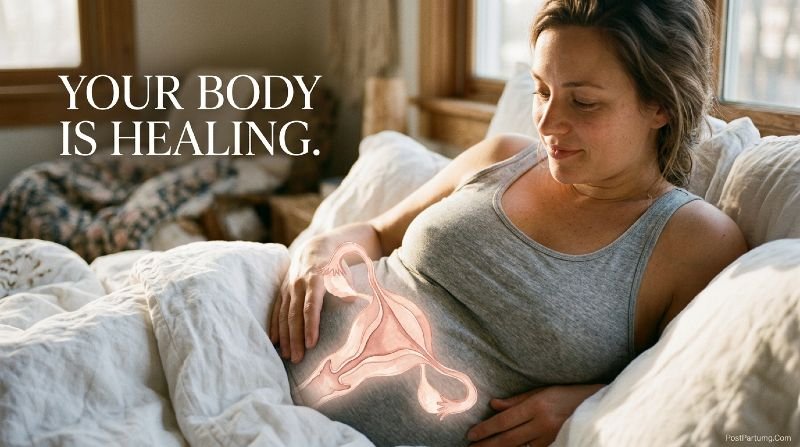
Your uterus just did something that has no real comparison in human biology. During pregnancy it expanded from roughly the size of a pear — weighing about 60 grams — into a muscular organ weighing close to 1,000 grams. Now your body has to reverse most of that transformation on its own, without surgery, without any special effort from you, and without a lot of fanfare.
Most new mothers hear almost nothing about this process until they’re in the middle of it. Then the cramping starts, the lochia flows, and questions pile up fast. This article explains exactly what uterus shrinking after birth involves — the biology, the timeline, the warning signs, and the practical things that actually matter for your recovery.
What Uterine Involution Actually Means
Uterine involution is the medical term for your uterus returning to its pre-pregnancy size and function. The word comes from Latin and roughly means “rolling inward” — which is a reasonable description of what happens.
Your uterine muscle fibers shorten and reabsorb through a process called autolysis. The body breaks down the extra cellular material it built during pregnancy and reclaims it as usable tissue. Nothing is wasted. The entire process runs on hormonal signals — primarily oxytocin — with no outside intervention required.
What makes this genuinely impressive is the scale of the change. A 900-gram reduction in organ size over six weeks, driven entirely by internal biology, is not a small event. It just happens quietly while you’re busy keeping a newborn alive.
According to ACOG postpartum care guidelines, understanding uterine involution is part of every comprehensive postpartum care plan — because knowing what normal looks and feels like is what allows you to recognize when something isn’t right.
The Biological Mechanism Behind the Shrinkage
Oxytocin drives the early stages of postpartum uterine recovery. This hormone triggers uterine muscle contractions immediately after the placenta delivers. Those contractions clamp down the blood vessels at the placental attachment site — which is critical for preventing hemorrhage.
As contractions continue over the following days, the uterine walls thicken while the overall size decreases. The muscle fibers themselves go through programmed cell death — apoptosis — reducing the total number of cells present. The remaining cells shrink back toward their pre-pregnancy dimensions.
The endometrial lining, which built up throughout pregnancy to support the placenta, sheds progressively as lochia. This shedding is part of involution, not separate from it. By the end of this process, the uterus has shed roughly 85% of the tissue it gained during pregnancy. That tissue gets broken down and reabsorbed, or shed through lochia. Either way, the body uses it efficiently.
Week-by-Week Timeline: Uterus Shrinking After Birth
The postpartum uterus timeline follows a consistent pattern for most women, even though individual sensations vary significantly.
| Timeframe | Fundal Position | Primary Process | Common Sensations |
|---|---|---|---|
| Birth to 24 hours | At or just below navel | Contractions clamping placental site | Cramping, pressure, afterpains |
| Days 1–4 | 1–4 cm below navel | Rapid muscle contraction, heavy lochia | Strong afterpains, especially with nursing |
| Days 4–7 | Approaching pubic bone | Continued shrinkage, lochia transitioning | Decreasing cramping, lighter bleeding |
| Week 2 | Below pubic bone, not palpable | Endometrial shedding, autolysis active | Mild discomfort, lochia serosa |
| Weeks 3–4 | Deep in pelvis | Cellular reabsorption ongoing | Minimal symptoms, lochia alba |
| Week 6 | Near pre-pregnancy size | Basic involution complete | Usually no specific symptoms |
| Weeks 8–12 | Fully involuted | Complete tissue remodeling | No specific symptoms |
Hours 0–24 After Delivery
Immediately after birth, the fundus — the top of the uterus — sits at or just below the navel. Your care team will press on your abdomen periodically to check that the uterus feels firm. A firm uterus means it’s contracting properly. A soft or “boggy” uterus signals that contractions aren’t strong enough, which can lead to postpartum hemorrhage.
Afterpains begin within hours of delivery. For first-time mothers these often feel like moderate menstrual cramps. For women who’ve given birth before, they can be substantially stronger because the uterus has a more established oxytocin response pathway.
Days 1 Through 7
This first week sees the most dramatic changes. The fundus descends approximately one centimeter per day. By day seven, it has typically dropped below the pubic bone and is no longer palpable from the outside.
Lochia is heaviest during this period. Bright red bleeding with small clots is expected in the first four days. Passing a clot larger than a golf ball after the first 24 hours warrants a call to your provider.
Afterpains peak during breastfeeding sessions in this window. Every nursing session triggers an oxytocin release, which causes the uterus to contract noticeably. This is uncomfortable but productive — and it’s why breastfeeding mothers often experience more intense cramping in the early days.
Weeks 2 Through 6
Visible and palpable changes slow considerably after the first week. The uterus continues shrinking and remodeling, but you won’t feel it the same way. Lochia transitions from pinkish-brown to a yellowish-white discharge — lochia alba — by weeks three to four.
By around six weeks, most women are close to the expected baseline uterine size, though internal healing continues beyond that point. The six-week postpartum visit is a standard checkpoint, not a guarantee that every aspect of healing is complete.
Understanding what your lochia should look like at each stage is genuinely useful for tracking recovery. Our detailed guide on postpartum bleeding stages explains what’s normal versus what needs attention at each phase.
Weeks 6 Through 12
Some aspects of internal recovery continue beyond six weeks, particularly for women with cesarean birth or postpartum complications. The uterus reaches its baseline dimensions around week six, but the internal tissue architecture continues remodeling for weeks afterward.

How Breastfeeding Affects Uterine Recovery
The connection between nursing and uterus shrinking after birth is direct and measurable. Every time your baby latches, your hypothalamus signals the pituitary gland to release oxytocin. That oxytocin reaches the uterus within seconds and causes muscle contractions.
According to research cited in the WHO Recommendations on Postnatal Care, breastfeeding accelerates early uterine involution — but both groups reach the same endpoint by week six. The difference largely equalizes regardless of feeding method.
This explains why nursing sessions in the first week often feel crampy. That discomfort is the uterus responding exactly as it should. If you’re not breastfeeding, your uterus still involutes completely on a normal timeline. Formula feeding does not compromise uterine recovery.
Cesarean Birth and Uterine Involution
The uterus involutes on a similar timeline after cesarean birth. The fundamental biology doesn’t change based on delivery method. What changes is the additional healing happening at the uterine incision site and the abdominal wall.
Women recovering from cesarean delivery are managing two distinct healing processes simultaneously. The uterine incision heals through scar formation internally, which adds complexity to overall recovery even if the involution timeline itself remains comparable.
Research also suggests that women with multiple prior cesareans may experience slightly altered uterine contractility, potentially affecting early involution. This is worth discussing with your OB if it applies to you.
The external scar tells a different story than the internal one. Our comprehensive guide on C-section scar healing addresses both layers of that process in practical detail.
What Slows Down Involution: Subinvolution
Subinvolution — delayed or incomplete uterine recovery — is uncommon but important to recognize. It can be caused by retained placental tissue, uterine infection (endometritis), or occasionally uterine fibroids that interfere with normal contraction.
According to the NIH Maternal Health Database, the most common causes of subinvolution include retained placental fragments and endometritis — both of which require prompt clinical treatment.
Warning signs that involution may not be progressing normally:
- Heavy bleeding that persists or returns after lightening
- Lochia with a foul or unusual odor at any stage
- A uterus that remains enlarged or tender beyond the first week
- Fever above 100.4°F (38°C) combined with pelvic pain
- Passing clots larger than a golf ball after the first 24 hours
- Increasing pain rather than decreasing pain after day three
Knowing the signs of postpartum infection helps you distinguish between normal recovery discomfort and something that needs prompt medical evaluation.
Seek immediate care if you experience:
- Soaking more than one pad per hour for two consecutive hours
- Fever above 100.4°F combined with uterine tenderness
- Foul-smelling discharge at any point in recovery
- Severe worsening abdominal pain after the first few days
- Signs of infection that feel beyond normal postpartum fatigue

Myth vs. Reality: Common Misconceptions About Uterine Recovery
| Common Claim | What the Evidence Shows |
|---|---|
| Belly binding speeds up uterine shrinkage | No credible evidence supports this. Involution is driven by internal hormonal signals. External compression does not accelerate it. Belly binding may offer comfort but not through uterine effects. |
| Six weeks means full recovery | Six weeks marks basic involution completion — not total postpartum recovery. Pelvic floor, hormonal system, and abdominal wall all operate on longer timelines. |
| You should feel the uterus shrinking throughout | Most involution after the first week happens without noticeable sensation. Absence of cramping does not indicate the process has stalled. |
| A C-section delays uterine shrinkage significantly | The uterus itself involutes on a similar schedule. The difference is the additional healing of the surgical incision and abdominal wall — not the involution timeline. |
| Afterpains signal a problem | Afterpains are a reliable sign of healthy uterine contractions. They’re stronger in women who’ve had previous pregnancies and during breastfeeding. They indicate involution is active. |
| Formula feeding prevents proper uterine recovery | False. The uterus involutes fully without breastfeeding. Nursing accelerates early progress but both groups reach the same endpoint by six weeks. |
The Pelvic Floor Connection
The pelvic floor and the uterus are anatomically interrelated. As the uterus shrinks and repositions itself deeper in the pelvis during involution, the surrounding pelvic floor structures — muscles, fascia, and ligaments — adapt in response.
Many women experience pelvic heaviness, a sensation of downward pressure, or the feeling that things have shifted internally in the first few weeks. This is anatomically accurate. Things have shifted. The uterus is moving back toward its pre-pregnancy position as it shrinks, and the pelvic floor is adjusting alongside it.
Pelvic floor physical therapy has become a much more standard part of postpartum care, and for good reason. A pelvic floor PT does more than teach Kegel exercises — they assess the full structural impact of pregnancy and birth on pelvic function. The complete picture is covered in our guide on pelvic floor recovery after birth.
Practical Support for Healthy Involution
Your body manages uterine involution independently. There’s no specific action required to make it happen. What you can do is avoid behaviors that interfere with it and support your overall recovery environment.
What genuinely supports recovery:
- Rest takes priority above almost everything else in the first two weeks. When your body is not managing physical exertion, it directs resources toward internal healing.
- Hydration matters more than most new mothers realize. Blood volume is redistributing, the kidneys are clearing retained pregnancy fluid, and lochia represents ongoing fluid loss.
- Appropriate pain management keeps your body from sustaining unnecessary stress responses. Ibuprofen is commonly recommended postpartum when there are no contraindications — partly because of its anti-inflammatory properties alongside pain relief.
- Attending postpartum appointments gives your provider the opportunity to physically assess involution progress, check lochia, and identify subinvolution early if it’s occurring.
What works against recovery:
- Returning to high-intensity exercise before the body is ready
- Ignoring warning signs because postpartum is supposed to feel hard
- Missing postpartum appointments when recovery seems “fine”

Frequently Asked Questions
Basic involution — returning to near pre-pregnancy size — takes approximately six weeks for most women. Full tissue remodeling including endometrial restoration takes closer to 10–12 weeks. Both timelines are normal and expected.
No. Cramping during nursing sessions in the first week or two is a reliable sign that oxytocin is triggering uterine contractions — exactly what should happen. It indicates healthy involution progress. The intensity decreases as involution advances.
Abdominal appearance at four weeks is not a reliable indicator of uterine position. The uterus itself is likely well into involution. What remains visible is typically a combination of abdominal muscle separation (diastasis recti), redistributing fat, and skin laxity — none of which reflect uterine size.
The uterus involutes on a similar timeline regardless of delivery method. Cesarean recovery is more complex because of the surgical incision healing simultaneously, but the involution process itself is not significantly delayed.
Subinvolution typically presents as persistent heavy bleeding beyond the first week, lochia that returns to bright red after lightening, a uterus that feels enlarged or tender on examination, or foul-smelling discharge. Fever accompanying these symptoms requires immediate evaluation.
Light walking is generally appropriate within the first week for uncomplicated vaginal deliveries. Structured exercise, including pelvic floor rehabilitation, is typically not recommended until after the six-week visit and clearance from your provider. Even then, gradual progression is important.
Normal afterpains are cramping that peaks in the first three days, worsens during nursing, and gradually decreases over the first week. Concerning symptoms include pain that worsens rather than improves after day three, fever alongside cramping, unusually heavy bleeding, or foul-smelling discharge.
Sources
- American College of Obstetricians and Gynecologists (ACOG) — Optimizing Postpartum Care
- World Health Organization (WHO) — Recommendations on Postnatal Care of the Mother and Newborn
- National Institutes of Health (NIH) — Maternal Health and Postpartum Complications
- Postpartum Support International (PSI) — Postpartum Resources
- Society for Maternal-Fetal Medicine — Patient Education Resources
All information reflects evidence available as of 2026.


