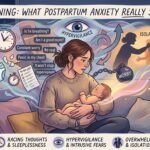


You’re sitting in your OB’s office, and she mentions your “perinatal care plan.” Last week, the nurse talked about your “postpartum recovery.” Are these the same thing? And does it even matter which word your doctor uses?
Understanding the difference between perinatal vs postpartum isn’t just about vocabulary. These terms shape the kind of care you receive, when you receive it, and how your healthcare team screens for conditions like depression and anxiety. Whether you’re pregnant, recently gave birth, or supporting someone who has, knowing what these pregnancy medical terms actually mean can help you advocate for better care. This article breaks down both terms, compares them side by side, and explains why the distinction matters — for you and your baby.
Medical Disclaimer: This article is for informational purposes only and is not a substitute for professional medical advice, diagnosis, or treatment. Always consult a qualified healthcare provider with any questions about your health or a medical condition. If you or someone you know is in crisis, call the 988 Suicide & Crisis Lifeline (call or text 988) or go to the nearest emergency room.
📋 Key Takeaways
- “Perinatal” covers the period from pregnancy through the first year after birth, while “postpartum” refers specifically to the time after delivery.
- The perinatal period is broader — it includes the postpartum phase within it.
- Perinatal depression can start during pregnancy, not just after birth.
- Organizations like ACOG and WHO have shifted toward using “perinatal” to capture the full timeline of maternal mental health concerns.
- Understanding these terms helps you get the right screenings and support at the right time.
- Both terms are used in clinical settings, but they aren’t interchangeable.
What Does “Perinatal” Actually Mean?
The word perinatal comes from two parts: “peri-” (meaning around) and “natal” (meaning birth). Put them together, and you get “around the time of birth.” But what does that look like in practice?
In medical settings, the perinatal period covers a broader window than most people realize. It starts during pregnancy — sometimes as early as conception — and extends through the first 12 months after delivery. Some definitions narrow it down to the period from the 20th week of pregnancy through the 28th day after birth, but this varies depending on the organization and context.
The perinatal meaning in everyday maternal care usually refers to the full journey from pregnancy through the first year postpartum. This broader definition has become more common in recent years, especially when talking about mental health conditions like perinatal depression or perinatal anxiety.
The Timeline of the Perinatal Period
So how long is the perinatal period, exactly? It depends on who you ask.
The World Health Organization (WHO) defines the perinatal period as starting at 22 completed weeks of gestation and ending seven days after birth. This is a very narrow, clinical definition mostly used for tracking perinatal mortality — deaths that happen around the time of birth.
However, when it comes to maternal mental health, organizations like the American College of Obstetricians and Gynecologists (ACOG) and the American Psychiatric Association (APA) use a much wider window. In this context, perinatal spans from pregnancy through the first year after giving birth.
Here’s the thing — the timeline you’ll encounter depends on whether your provider is talking about:
- Perinatal mortality (narrow definition: late pregnancy to the first week after birth)
- Perinatal mental health (broad definition: pregnancy through 12 months postpartum)
- Perinatal care (general: all care related to pregnancy, birth, and early postpartum)
For most new parents reading this, the broader definition is the one that matters most. If your doctor mentions “perinatal care,” they’re usually talking about the full spectrum from prenatal to postnatal care.
If you’ve come across shortened medical terms like “PND” or “PMH,” these abbreviations often refer to perinatal conditions that span this entire timeline.
Is Perinatal the Same as Postnatal?
Not quite. Postnatal specifically means “after birth.” It overlaps with the second half of the perinatal period but doesn’t include pregnancy. In many countries — particularly the UK and Australia — “postnatal” is the preferred term for what Americans typically call “postpartum.”
Think of it this way:
- Prenatal = before birth
- Postnatal/Postpartum = after birth
- Perinatal = the umbrella term that covers both
So if someone asks, “is perinatal the same as postnatal?” — the answer is no. Postnatal is one part of the larger perinatal picture.

The Postpartum Period — More Than Just “After Birth”
When most people hear “postpartum,” they think of the weeks right after having a baby. And they’re not wrong — but the postpartum period covers more ground than those first exhausting days.
The postpartum definition refers to the time after childbirth. In medical terms, it specifically describes the mother’s recovery phase. This is the window when your body adjusts back from pregnancy, hormones shift dramatically, and you’re adapting to life with a newborn (or adding another child to the family).
But how long does this period actually last?
How Long Does the Postpartum Period Last?
Traditionally, the medical community defined the postpartum period as the first six weeks after delivery. This six-week window lines up with the typical postpartum checkup, where your provider assesses your physical recovery.
However, ACOG updated its recommendations in 2018, calling for the postpartum period to be recognized as lasting up to 12 months — and for care to extend well beyond that single six-week visit. The reasoning? Many postpartum concerns — from mood disorders to pelvic floor issues — don’t resolve in six weeks. Not even close.
For a closer look at the physical side of this recovery period, our guide on how long postpartum bleeding lasts covers one of the earliest and most common experiences after delivery.
Physical and Emotional Changes After Delivery
The postpartum period brings a flood of changes. Your body is recovering from one of the most physically demanding experiences it can go through. Meanwhile, your emotions may swing wildly — sometimes within the same hour.
Physical changes after delivery can include:
- Uterine contractions as your uterus shrinks back to its pre-pregnancy size
- Postpartum bleeding (lochia) that lasts several weeks
- Breast engorgement and the start of milk production
- Hormonal drops — especially estrogen and progesterone
- Deep fatigue from sleep deprivation and physical recovery
- Changes in hair, skin, and weight
Emotional changes are just as real:
- “Baby blues” (mood swings, crying, irritability in the first two weeks)
- Bonding with your baby — which doesn’t always feel instant, and that’s okay
- Anxiety about your baby’s health and safety
- Feeling overwhelmed or isolated
- For some, deeper symptoms of postpartum depression or anxiety
The emotional side is where the difference between perinatal and postpartum becomes especially meaningful. Because here’s something many people don’t realize: mood disorders can start during pregnancy, not just after. And that distinction matters more than most people think.
Perinatal vs Postpartum: A Side-by-Side Comparison
Sometimes the clearest way to understand these before and after birth period definitions is to see them next to each other. Here’s a direct breakdown:
| Feature | Perinatal | Postpartum |
|---|---|---|
| Meaning | Around the time of birth | After birth |
| Timeline | Pregnancy through 12 months after delivery (broad definition) | From delivery through 6–12 months after birth |
| Includes pregnancy? | Yes | No |
| Common usage | Mental health, overall maternal care | Physical recovery, mood disorders after delivery |
| Related depression term | Perinatal depression (during or after pregnancy) | Postpartum depression (after delivery only) |
| Who uses it | ACOG, WHO, APA, researchers | General public, many healthcare providers |
| Focus | Mother and sometimes baby outcomes | Primarily the mother’s recovery |
The key takeaway from this comparison? “Perinatal” is the wider term. It wraps around the entire experience — pregnancy and postpartum combined. “Postpartum” zooms in on the after-delivery phase only.
Both terms matter. Neither one is “wrong.” But they describe different windows of time, and that has real consequences for how care gets delivered.
Why Do Doctors Use Different Terms?
If these terms overlap so much, why can’t everyone just pick one and stick with it? Good question. The answer lies in how obstetric terminology has evolved — and how different medical contexts require different levels of precision.
How Obstetric Terminology Shapes Your Care
The words your doctor chooses aren’t just academic jargon. They determine real things about your experience:
- When you get screened. If your provider thinks of mood disorders as “postpartum” only, they may not screen during pregnancy. A “perinatal” framework means screening starts earlier — often during the second trimester.
- What treatments get discussed. Some medications are safer during pregnancy than others. A perinatal approach considers this full timeline when building a treatment plan.
- How long your care continues. The old six-week postpartum visit left a massive gap. A perinatal model extends support much further.
- How your records are coded. Medical billing codes tied to “postpartum” vs. “perinatal” can affect what services your insurance covers.
For instance, if you want to understand what PPD stands for and how it gets diagnosed, you’ll notice that many providers now screen for depressive symptoms during pregnancy — not just after birth. That shift reflects the move toward perinatal thinking.
What ACOG and WHO Say About These Definitions
ACOG has been a driving force in redefining the postpartum period. Their 2018 committee opinion called the weeks after birth the “fourth trimester” and recommended ongoing care rather than a single checkup at six weeks. They also increasingly use “perinatal” language when discussing mood and anxiety disorders.
The WHO uses “perinatal” primarily in the context of birth outcomes and mortality data. Their definition focuses on the period from 22 weeks of gestation through the first seven completed days after birth. This narrower definition is geared toward tracking infant and maternal deaths — a very different purpose from mental health care.
The APA updated the Diagnostic and Statistical Manual of Mental Disorders (DSM-5) to include a “with peripartum onset” specifier for major depressive episodes. This means depression that begins during pregnancy or within four weeks of delivery qualifies. Worth noting: “peripartum” is yet another related term. Many clinicians use “perinatal” and “peripartum” interchangeably in conversation, even though the DSM-5 technically uses “peripartum.”
The bottom line? Different organizations define these obstetric time periods slightly differently based on their purpose. As a patient, the most useful thing you can do is ask your provider, “What does that term mean in my care?”

Perinatal Depression vs Postpartum Depression — What’s the Real Difference?
This is where terminology gets personal. If you’re struggling with your mood during pregnancy or after having a baby, the words used to describe what you’re going through might seem like the last thing that matters. But they actually shape the help you receive.
Perinatal depression is the broader term. It covers depressive episodes that start during pregnancy OR after giving birth. Postpartum depression is more specific — it refers only to depression that appears after delivery.
Here’s why this matters: research suggests that a significant number of women diagnosed with “postpartum depression” actually began experiencing symptoms during pregnancy. [VERIFY: exact percentage — some ACOG and NIMH sources cite approximately 50%] That means calling it only “postpartum” misses a huge part of the picture.
Our detailed guide on PPD depression, its meaning, risk factors, and recovery tips explores postpartum depression specifically. But understanding the perinatal framework helps you see that depression during pregnancy is equally valid — and equally deserving of treatment.
Why the Shift Toward “Perinatal” Matters
In recent years, many mental health organizations have started replacing “postpartum depression” with “perinatal depression” — or at least using both terms together. Why the change?
- Earlier detection. When providers screen only after birth, they miss months of potential suffering during pregnancy.
- Less stigma during pregnancy. Some expectant mothers feel they “shouldn’t” be depressed because they haven’t had the baby yet. Using “perinatal” normalizes the experience and gives it a name.
- Better treatment planning. If depression starts at 28 weeks of pregnancy, the treatment approach will differ from depression that emerges three months postpartum. Medications, therapy approaches, and support strategies may all look different.
- Research accuracy. Studies that track “perinatal mood disorders” capture a more complete and honest picture than those focused only on the postpartum window.
The National Institute of Mental Health (NIMH) now uses “perinatal depression” as its primary term on its website, noting that the condition includes both prenatal and postpartum depression. This shift from a leading federal agency signals where the field is heading.
How Screening Changes Based on Terminology
When a healthcare system adopts perinatal language, screening practices tend to expand. Instead of giving you the Edinburgh Postnatal Depression Scale (EPDS) only at your six-week postpartum visit, providers may screen:
- During each trimester of pregnancy
- At the postpartum hospital stay
- At the six-week postpartum visit
- At well-baby visits throughout the first year
- Any time you report mood changes to your provider
This approach catches more cases and catches them earlier. And earlier detection usually means better outcomes — for both parent and baby.
If you’re curious about postpartum anxiety specifically — a condition that often shows up alongside depression — our article on PPA meaning explains what to look for and when to talk to your provider about it.
The Prenatal to Postnatal Timeline Explained
Let’s map out the full pregnancy and birth period so you can see exactly where each term fits. Think of it as a timeline of maternal care phases, from the moment you find out you’re expecting through your baby’s first birthday.
Before Birth: The Prenatal Phase
The prenatal (or antenatal) period spans from conception to the start of labor. During this time, your care focuses on:
- Monitoring the baby’s growth and development
- Managing pregnancy symptoms and any complications
- Screening for genetic conditions and other risk factors
- Tracking your blood pressure, weight, and overall health
- Addressing any existing health conditions — including mental health
Prenatal care is the foundation of healthy pregnancy outcomes. It’s also where perinatal mental health screening should begin. If your provider isn’t asking about your mood during pregnancy, it’s completely okay to bring it up yourself.
During and After Birth: Where Perinatal and Postpartum Overlap
Here’s where people get confused. The perinatal period includes both the late prenatal phase and the postpartum phase. So there’s a significant area of overlap.
Picture it as nested circles:
- The largest circle is the perinatal period (pregnancy + postpartum)
- Inside it sits the prenatal period (pregnancy only)
- Also inside it sits the postpartum period (after birth only)
Both prenatal and postpartum live under the perinatal umbrella. That’s why “perinatal care” is such a useful phrase — it covers everything a mother needs across the full prenatal to postnatal timeline.
During the labor and delivery itself, you might hear the term intrapartum, which means “during birth.” This is the brief but intense transition between the prenatal and postpartum periods.
So the full childbirth terminology timeline looks like this:
- Preconception — before pregnancy begins
- Prenatal/Antenatal — from conception to labor
- Intrapartum — during labor and delivery
- Postpartum/Postnatal — after delivery through 6–12 months
- Perinatal — the umbrella covering steps 2 through 4
Each of these before and after delivery terms serves a specific purpose. Understanding where you fall on this timeline helps you know what kind of care to expect — and what to ask for.

How These Terms Affect Your Maternal Care
You might be thinking, “This is all interesting, but does it actually change anything for me day-to-day?” The truth is — yes, it can. The maternal health terminology your providers use can shape your entire care experience in ways you might not expect.
Insurance, Medical Records, and Terminology
In the United States, health insurance coverage often ties to specific medical codes and terminology. The postpartum period has traditionally been defined as six weeks for insurance purposes. That meant many mothers lost coverage or access to certain services after that narrow window closed — right when some were just starting to struggle.
The push to recognize a longer postpartum period (and the broader perinatal framework) has led to real policy changes. As of recent years, many states have expanded Medicaid postpartum coverage from 60 days to 12 months. [VERIFY: current number of states with extended Medicaid postpartum coverage as of 2025]
This expansion reflects what healthcare providers have known for a long time — maternal health needs don’t stop at six weeks. Whether you call it extended postpartum care or comprehensive perinatal care, the result is more support for mothers who need it.
Talking to Your Provider About Your Care Phase
You don’t need a medical degree to advocate for yourself. But knowing a few key terms from this pregnancy and birth period definitions guide can help you have better conversations with your care team:
- Ask better questions. “Should I be screened for perinatal depression?” is more specific and powerful than “Am I doing okay?”
- Understand your records. If your chart mentions “perinatal mood disorder,” you’ll know what that means and why it matters.
- Push for follow-up care. If your provider seems to focus only on the six-week postpartum checkup, you can ask about ongoing perinatal support.
- Connect with the right resources. Searching “perinatal depression support” will lead you to different resources than “postpartum depression help” — and both sets of resources are valuable.
For a more detailed look at recognizing early symptoms and knowing when to ask for help, check out our guide on early signs of PP depression and how to get help.
Common Misconceptions About Pregnancy Medical Terms
There’s a lot of confusion swirling around before and after delivery terms. Let’s clear up the most common misunderstandings — some of which can actually delay mothers from getting help.
Misconception #1: “Perinatal” and “postpartum” mean the same thing.
They don’t. Perinatal includes pregnancy; postpartum does not. They overlap, but they aren’t interchangeable.
Misconception #2: Postpartum depression can only happen right after birth.
This is a harmful myth. Postpartum depression can develop anytime in the first year after delivery. And if we use the perinatal framework, depressive symptoms during pregnancy count too — and they count equally.
Misconception #3: “Perinatal” only applies to the baby.
While “perinatal” is sometimes used in reference to infant outcomes (like perinatal mortality rates), it applies to mothers just as much. Perinatal mental health, perinatal care, and perinatal support all center the mother’s experience.
Misconception #4: These terms are just jargon — they don’t affect real care.
As we covered above, terminology influences screening schedules, insurance coverage, and treatment approaches. Words carry weight in healthcare.
Misconception #5: If you’re feeling depressed during pregnancy, that’s just hormones acting up.
Prenatal depression is a real clinical condition that affects an estimated 7% to 20% of pregnant individuals. [VERIFY: current prevalence rates for prenatal depression] Dismissing it as “just hormones” delays treatment and can worsen outcomes for both parent and baby. The perinatal framework takes these feelings seriously — and so should everyone around you.
Misconception #6: Only biological mothers experience postpartum or perinatal mood disorders.
Research shows that adoptive parents, fathers, and non-birthing partners can also experience perinatal mood and anxiety disorders. [VERIFY: current prevalence estimates for paternal perinatal depression] The emotional weight of adjusting to parenthood is universal, even when the hormonal component differs.

You Are Not Alone — Support Exists at Every Stage
Whether you’re in the prenatal, postpartum, or somewhere-in-between phase, support is out there. And you deserve it at every point on the timeline — not just after delivery.
Here’s what support can look like during different maternal care phases:
During pregnancy (prenatal/perinatal):
- Prenatal mental health screening at your regular OB visits
- Therapy or counseling for anxiety and depression
- Support groups for expectant mothers — both in-person and online
- Medication management with a provider who understands pregnancy
- Honest conversations with your partner, family, or close friends
After delivery (postpartum/perinatal):
- Postpartum depression and anxiety screening at checkups
- Postpartum doula or lactation support
- Individual or group therapy with a perinatal specialist
- Peer support through organizations like Postpartum Support International
- Medication if recommended by your provider
- Couples counseling to navigate the transition together
Throughout the entire perinatal period:
- Continuous care with a provider who sees the full picture — not just snapshots
- A birth plan that includes mental health goals alongside delivery preferences
- Open communication about how you’re feeling, even when it’s hard to put into words
- Grace for yourself on the hard days
Many mothers struggle silently because they think what they’re experiencing isn’t “bad enough” to warrant help. Let’s be honest — you don’t need to reach a crisis point before you deserve support. Even mild symptoms are worth mentioning to your provider.
For a deeper understanding of more severe conditions that can develop during the perinatal period, our article on understanding postpartum depression psychosis in mothers covers the warning signs that require immediate attention.
When to Seek Professional Help
Knowing the difference between perinatal and postpartum terms is helpful. But knowing when to reach out for help? That’s what can genuinely change your life — and maybe save it.
Talk to your healthcare provider if you experience any of the following during pregnancy or after delivery:
- Persistent sadness or hopelessness lasting more than two weeks
- Severe anxiety or panic attacks that interfere with daily life
- Difficulty bonding with your baby despite wanting to
- Loss of interest in activities you used to enjoy
- Sleep changes beyond what’s normal with a newborn — either unable to sleep when the baby sleeps, or unable to get out of bed
- Intrusive, frightening thoughts about harm to yourself or your baby
- Feeling like your baby would be better off without you
- Withdrawing from family, friends, or your partner
- Appetite changes — eating too much or barely eating at all
- Feeling numb, disconnected, or like you’re just “going through the motions”
These symptoms deserve attention regardless of whether you’re in the prenatal or postpartum phase. That’s exactly why the perinatal framework matters — it validates your experience at any point on the timeline. You shouldn’t have to wait for a specific label to get the help you need.
If you or someone you know is in crisis, please reach out now:
- 988 Suicide & Crisis Lifeline: Call or text 988
- Postpartum Support International Helpline: 1-800-944-4773 (call or text)
- Crisis Text Line: Text HOME to 741741
- Emergency: Call 911 or go to the nearest emergency room
You are not weak for asking for help. You’re protecting yourself and your family. That takes real strength.
Frequently Asked Questions
Does perinatal include pregnancy?
Yes. The term “perinatal” covers the period from pregnancy through the first year after birth, according to the broader definition used in maternal mental health. Unlike “postpartum,” which begins after delivery, the perinatal period specifically includes the prenatal phase. This is why healthcare providers can diagnose “perinatal depression” during pregnancy — it doesn’t have to wait until after the baby arrives.
When does postpartum officially start?
The postpartum period begins immediately after the delivery of the baby and the placenta. Traditionally, the medical community defined it as lasting six weeks. However, current guidelines from ACOG recognize that postpartum recovery and related health concerns can extend through the first 12 months after birth. Your provider should continue supporting you well beyond that initial six-week checkup.
Is perinatal depression different from postpartum depression?
Perinatal depression is the broader category. It includes depression that starts during pregnancy as well as depression that develops after delivery. Postpartum depression is technically a subset of perinatal depression, referring specifically to depressive episodes that begin after giving birth. Many clinicians and organizations — including the NIMH — now prefer “perinatal depression” because it captures the full timeline and encourages earlier screening.
How long is the perinatal period?
This depends on the context. The WHO defines it narrowly as 22 weeks of gestation through seven days after birth — mainly for tracking mortality data. For maternal mental health purposes, it typically spans the entire pregnancy through 12 months postpartum. Your provider’s definition may vary, so it’s worth asking what they mean when they use the term.
Why do doctors use different terms?
Doctors choose their terms based on the clinical context. “Postpartum” tends to be used when focusing specifically on the after-delivery period — physical recovery, bleeding, breastfeeding, and mood changes. “Perinatal” is used when the conversation spans the full pregnancy-through-postpartum timeline, particularly for mental health conditions. Different medical organizations also have slightly different definitions, which adds to the variation you might encounter.
Can fathers experience perinatal depression?
Yes. Research shows that non-birthing partners, including fathers, can experience perinatal mood disorders. While the hormonal shifts are different from what birthing parents go through, the stress, sleep deprivation, relationship changes, and emotional weight of new parenthood can trigger depression and anxiety in any parent. If you’re a partner who’s struggling, you deserve support too — don’t hesitate to reach out.
Is postnatal the same as postpartum?
Essentially, yes. “Postnatal” and “postpartum” both refer to the period after birth and describe the same timeframe. The main difference is regional: “postpartum” is the standard term in the United States, while “postnatal” is preferred in the UK, Australia, and many other English-speaking countries. If you see either term in medical literature, they’re talking about the same thing.
Conclusion
Understanding perinatal vs postpartum isn’t just about memorizing medical definitions — it’s about knowing what kind of care you’re entitled to and when you should receive it.
The perinatal period wraps around your entire experience from pregnancy through the first year with your baby. The postpartum period focuses specifically on the time after delivery. Both terms describe real, important phases of your maternal health journey. And neither one is more “correct” than the other — they serve different purposes in different contexts.
What matters most? That you get the support you need at every stage. Whether you’re 20 weeks pregnant and feeling unlike yourself, or six months postpartum and struggling more than you expected, your feelings are valid. You don’t have to wait for a specific label or a specific point on the pregnancy and birth period timeline to ask for help.
Recovery is possible. Support is available. And understanding these terms puts you one step closer to getting the care you deserve.
If any part of this article resonated with you, please talk to your healthcare provider. You’re not alone in this — and asking for help is one of the bravest things a parent can do.