
Four months after delivery. Before going to sleep, you wish and pray that tomorrow will be different. But the heaviness stays. The numbness hasn’t budged. To just give it time is what somebody told you to do. Perhaps your mother told you that you would wake up. So you keep waiting. And nothing really changes.
And maybe, that is what you are going through now, you are not alone. Among the largest questions that new mothers pose is the duration that postpartum depression lasts. The truth is in nearly everything being determined by whether you receive assistance.
Baby Blues vs PPD: The Timeline Tells It All.
Virtually all the first-time mothers experience a period of difficulty after giving birth. The first two weeks were characterized by mood swings, crying spells, and pure exhaustion. This is referred to as the baby blues and it occurs in as many as 80 percent of new mothers. It dies of itself without treatment.
PPD is a totally different case. It manifests itself in the first few weeks and months after childbirth. Nonetheless, it does not lift in two weeks as in the blues. The symptoms penetrate further, cling longer and begin interfering with everyday living.
This is the most obvious way of distinguishing between them. Baby blues is like a tempest that ends in a short time. PPD is an illusion of a fog that has entered and it has settled. When you have been in your bad mood more than two weeks, then maybe you are dealing with something greater. These are the typical symptoms of postpartum depression, and you can check them to know your current position.
How Long Does the Postpartum Depression Last?
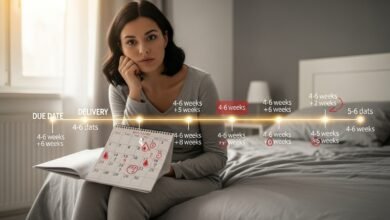
Research does not provide us with a certain number, but rather a range. The National Institute of Mental Health indicates that PPD may persist within a few months and far much longer. Even some studies demonstrate it getting even longer when not treated.
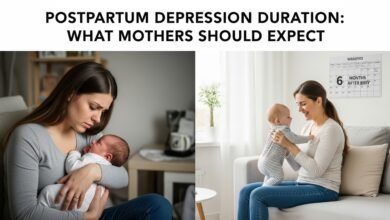
Most mothers also begin to feel well in 3 to 6 months with appropriate treatment. That is a great difference. It implies that the suffering period can be reduced by half or more with the help. But in the absence of treatment, how protracted is postpartum depression? The statistics are a dismal picture.
According to medical studies around half of women who do not receive treatment of PPD are still experiencing symptoms at 6 months after delivery. At one year, approximately 30 percent are still suffering. And in some mothers it goes way out past two or three years and degenerates into chronic major depression. Depending on your past, support and health, your experience may appear different. However, the trend is obvious: sitting and waiting usually do not go as planned.
The Untreated PPD Timeline: How Each Phase is Like.
Majority of the articles that are written concerning the duration of PPD provide a generalized range and proceed. And they do not tell us what it is like to experience each period of time internally. That gap matters. So let me walk you through it.

Months 1 to 3: The Quiet Buildup
Even you may not notice something is wrong in the beginning. You blame it on sleep deprivation, the tremendous readjustment to being a mother. Crying feels normal. Irritability seems justified. You just keep struggling on as it appears to be what everyone does.
However, something starts to change towards month two or three. The depression no longer comes and goes. It just sits there. You no longer get interested in things you enjoyed before and even the relationship with your baby seems tougher than you ever thought.
Majority of mothers during this stage do not seek help. They presume that they are experiencing what it is to be a new mother. It is precisely that presumption that helps PPD to root deeper in your everyday life.
Months 4, 6: The Settling In of the Weight.
At this time, the symptoms become more pressing and permanent. Even when the baby sleeps at night, the sleeping issues become even more serious. The change of appetite is more noticeable. On one day you can eat virtually nothing, and the next day, you can use food as a comfort.
It is also at this time that most mothers begin to alienate themselves. You make cancelations without even thinking. You shun your friends and leave phone calls on voicemail. The depression feeds the isolation and the isolation feeds the depression. It turns into a cycle which may hardly be broken without any help.
Your family members or partner will also begin to notice changes. Relationships become tense, quarrelling is more frequent and you cannot be understood. They feel helpless. Everybody is the victim, yet no one is aware of what exactly to do about it.
Months 7 to 12: The “New Normal” Trap
This is what the majority of people will not tell you. At this age, most mothers have stopped identifying the depression as depression. It just becomes your normal. You do not even remember how it was to feel good. You end up not comparing your present self to your previous self since the distance is too big.
This stage is perilous because of a suspicious motive. Not because the symptoms are at their worst, but because you have quit struggling against them. You have become accustomed to being terrible, and that acculturation makes you less likely to seek assistance in future.
Other mothers also develop anxiety symptoms along with the depression in this window. Overlapping between the two conditions is much more than many may think. The combined weight is greater than what either of them alone could bear.
Beyond the First Year: PPD Becomes Other.
By the second year, postpartum depression is likely to change when it is not treated. It ceases to be PPD, in the clinical meaning of the term, and turns to be chronic major depressive disorder. The postpartum tag is not significant at this stage. The thing is that you live with continuous depression that began in the aftermath of childbirth and remained unaddressed.
According to American College of Obstetricians and Gynecologists, the untreated perinatal mood disorders may have a permanent impact on a mother and a child. There are women who bear the burden of depression of three or more years to the point of never relating it to the postpartum experience. At that point, they have just come to terms with it as their identity.
Three Reasons PPD Refuses to Lift on Its Own
You may ask yourself, why not fix this your body? Hormones level off in the end, do they? This is not as layered as the truth.
1. Hormones are not the entirety but merely the trigger. PD can be triggered by the drop in dramatic hormones following birth. However, when you get depressed, your brain chemistry is altered in a manner that is not going to disappear with the hormonal change. The level of serotonin and dopamine remains low. Connections between the brain and mood and motivation are compromised. It is literally that your brain functions differently when you are depressed.
2. The pressure of motherhood is what keeps the fire going. There is the incessant lack of sleep, the need to care night and day, and the fact that your former self as a person is gone, and all these factors lead to endless pressure. Cortisol is maintained by that stress. Depression is aggravated by high cortisol. Unassisted, the stress-depression cycle just keeps on turning, no way out.
3. The withdrawal eliminates the potential helpers. You lose the emotional bonds that enable healing when you distance yourself with friends and family. Social support enables humans to heal faster once they are depressed. In its absence, the recovery is put on hold or not started at all.
The Damage You Can’t See Building.
Unattended PPD does not remain in place. It shines off and it reaches your everybody in life. And some of those impressions surprise mothers with a total shock.
Your relationship with your baby might be affected in a manner that is not so obvious. Studies indicate that maternal depression left unattended may influence the emotional regulation of a child and cognitive development during the early years of a child. Infants are sensitive to the mood of their mother way earlier than the parents are aware. A struggling mother is not doing badly. She’s dealing with an illness. However, when not treated, there is the emotional wall that may drift between mother and child without any notice.
Your association with your partner gets a blow as well. Partners have a tendency to feel excluded, disoriented or powerless. Communication fails, intimacy disappears and resentment is accumulated on both sides. Most of the couples who have encountered PPD without treatments describe the damages that were caused as taking years to be mended, which is even after the depression itself had been defeated.
Then how much does postpartum depression rob you of your confidence, who you are and enjoy your motherhood? Precisely as long as it passes unnoticed. That is the one that nobody can say aloud, yet all mothers who live it know it already.
How Getting Help Rebooks Your Schedule.
Herein lies the good news that this whole article has been leading to. Treatment works. And it is quicker than some mothers think it is.

Therapy
One of the best and most well-researched treatments of PPD is cognitive behavioral therapy. Most mothers actually see improvement in 6-12 sessions. In case you wonder how this is done, this CBT step-by-step guide to postpartum depression will deconstruct the process of what is done in these sessions.
Therapy provides actual useful instruments. You are taught to detect negative thoughts patterns, challenge them and substitute them with clearer thoughts. It is not the coercion to be good. It is all about learning again to see your situation in a proper perspective.
Medication
Antidepressants may be prescribed by your doctor particularly when your symptoms are moderate to severe. The most widely prescribed ones are SSRIs and most of them are said to be safe with breastfeeding. Majority of the women experience significant improvement between 4-6 weeks of medication.
It is natural to be a nervous person when it comes to taking medication. However, it is nice to be aware that these drugs do not alter your personality. They replenish the brain chemistry that PPD destroyed in the beginning. You are not turning into somebody different. You make a comeback to yourself.
Combining Both Approaches
Pairing treatment with medication is the most effective way to recover and it takes the shortest time. It is always found in studies that this combination is better than either of the two approaches applied separately. Explore these postpartum depression treatment options off to find the treatment that fits your life.
The Function of the practical Support.
Never undervalue daily assistance of people surrounding. It is important to have a partner that does two night shifts a week. It counts when a friend makes an appearance uninvited. It is important that postpartum support group is created where mothers discuss their difficulties freely. These items will not help PPD in isolation, but it will hasten the process when used alongside professional treatment.
| Factor | Without Treatment | With Treatment |
|---|---|---|
| Average duration | 6 months to 3+ years | 3 to 6 months |
| Symptom intensity over time | Stays flat or worsens | Gradually decreases |
| Risk of chronic depression | High | Significantly lower |
| Impact on mother-baby bond | Often strained over time | Usually improves early on |
| Relationship stress | Builds and compounds | Starts easing within weeks |
Red Flags You Have Stalled In Recovery.
Other mothers attempt to treat PPD independently by means of exercise, improved sleep patterns or diet. Those things genuinely help. However, they are not enough sometimes. Here are the indicators to monitor that it is time to change strategy.
The last two and more months have been bad with no or little good days. You no longer care about your baby or you are emotionally disconnected with your baby. Simplest tasks such as showering, having a meal or dressing is like climbing a mountain. The things you are thinking about have become dark or hopeless or scary.
Other people, another huge hint is that they see it first. In case your partner, or your mother or a close friend has expressed concerns on your mood, then take it with seriousness. Others looking at you may notice something that you are unable to realize because of how you gradually get used to a change.
In case you ever feel like injuring yourself, or your baby, you can contact us immediately. Or dial the Postpartum support international helpline 1-800-944-4773 or text HELP to 988 to access the Suicide and Crisis Lifeline. Help is available 24 hours a day.
When to Call Your Doctor (You Do Not Have to Be in a Crisis).
Most mothers do not seek help early enough since they do not think they have a bad symptom to warrant any intervention. Let me be direct about this. You do not need any particular amount of suffering to take the phone.

You do not have to be crying on a daily basis. The worst symptoms on the checklist are not necessary. The sense of dull, empty, doing-it-just-to-get-through-with-it kind of feeling is as real as much of the extreme sadness that is so visible. When something has been off longer than two weeks, then it is enough.
A brief screening instrument such as the Edinburgh Postnatal Depression Scale can help your physician to know your position. It can be completed within less than five minutes and nothing frightening about it. It is just a few questions, trying to get your provider to understand what is happening to you on the inside and outside.
It is possible to bring it to the next postpartum visit or call the office of your OB and request a mental health check specifically. You can even refer to it to the pediatrician of your baby. Most pediatricians are screening mothers nowadays when visiting well-baby clinics because they understand that a healthy baby begins with a healthy mother.
Missing in the Majority of Articles: PPD and Future Pregnancies.
This is one of the details which are buried too frequently. In case you had PPD without treatment when you gave birth to the first baby, the likelihood of having it when you give birth next time will go extreme. According to the Mayo Clinic, one of the best predictors of PPD recurrence is a personal history of PPD.
This is relevant since most mothers who go through a first-time PPD untreated white-knuckle their way through the initial attack. They survive it. This is finally followed by a painful period when they feel okay. Then they get another baby and it hits even worse. They are looking after a toddler and a new baby at the same time and the depression burrows even further.
Treating today does not just make you feel better today. It sets a platform that secures your future. You get to know your own warning signs. You establish a connection with a doctor or a therapist, who is aware of your background. You plod a strategy when the crisis is never again to be met. The thing is that that preparation can transform everything in the way your next postpartum experience would be.
And when you are anxious about what lies ahead it will bring you both enlightenment and optimism to read what new mothers need to know about PPD.
FAQ
Q: What is the duration of the postpartum depression with no treatment?
A: PPD, untreated, has a duration of 6 months to more than 3 years. In other instances it transforms into chronic major depression which lasts forever.
Q: Do you think that postpartum depression will resolve itself?
A: The mild cases occasionally do improve slowly. However, moderate to severe PPD seldom clears on its own and delaying it usually exacerbates it.
Q: How do you feel like getting over postpartum depression the fastest?
A: Therapy/Medication combination has the fastest outcome on most mothers. Large numbers experience a sense of significant improvement in 2 to 3 months of treatment.
Does a longer delay make postpartum depression worse?
A: Often, yes. PPD is progressive, and untreated PPD becomes worse with time with isolation, stress and disturbed brain chemistry compounding one another.
Q: Is it possible to develop postpartum depression 6 months after delivery?
A: Yes. PPD may be developed at any time during the first year of post partum. Cases that occur late in life are not exceptional and are as serious.
Q: Is it normal to continue to be depressed when there is a year since you have a baby?
A: Experiencing a continuous low mood at age one year after delivery is not the normal baby blues. It is a strong indication of PPD or chronic depression which requires professional handling.
Concern: Do I experience postpartum depression again with my next child?
A: In case of previous occurrence, the risk increases. The occurrence will be minimized by early detection and proactive treatment plan with your physician.
This is what you can take away with you in all that you have just read:
- The untreated PPD may range between 6 months and a few years and may even lead to a chronic depression.
- The recovery period is usually reduced to 3 to 6 months and the damage is prevented by treatment.
- You do not have to reach some level of suffering in order to be worth supporting.
- Receiving assistance today keeps your relationships, the development of your baby and your future pregnancies as well.
Your next action: This week, pick up the phone and request your doctor to screen you at the postpartum stage on the issue of depression. Such a call only takes a turn to reorient your recovery. You have been long enough waiting to see when the fog will clear. At this point you are free to do the very thing that becomes of it. You need to feel like yourself once again, and that you is not as far away as you believe it is.
The article can only be informative and not a substitute of a professional medical advice. The health care system is always consulted with a physician or health provider to offer advice.